Monday, November 23, 2009

Ludic Dialogue

My curatorial collaborator at Ludic Pyjamas (where one can immerse themselves in various forms of dreamplay), has an excerpt from the UNREALTIME catalog interview:
DD: Postproduction and remix have played a central role in your work. When discussing your approach you refer more to ideas such as the détournement of the Situationists rather than Bourriaud's or Manovich's positions on postproduction and remix culture. Could you explain to us how do you understand postproduction and remix with reference to your work's development?

MA: You could say that my approach to remix and/or postproduction culture is more akin to a philosophical investigation of what it means to be creative, that we are all born-remixers, and as such we are continually sampling from the datum that surround us and innovating new forms of aesthetic viability. I call this datum Source Material Everywhere – it's literally and metaphorically in the air, ready for downloading, and how we access it, what we do with it once we sample from it, that is to say, how we manipulate it as postproduction artist-mediums, is what makes us unique artists, what Alfred North Whitehead might call "actual entities" ... There can be no doubt that the seemingly very banal concepts of "remix" and "postproduction" are being applied to all kinds of contemporary art practice perhaps to the point where the methodologies that are triggered by the concepts start to lose their value as an avant-methodology. If everything in art can be reduced to "remix" then do we risk simplistically applying it to a wide array of media forms where it soon loses its power to intervene in the mainstream meaning-making process? It's like what has happened to the word "creativity" i.e. there is always the risk of it becoming completely neutered by the corporate behemoth. But for me, there is a deep connection between the desire to create, to innovate new forms of becoming-artist, and the quite natural way we are all operating in auto-remix mode. The idea of remix has to be more than just a conceptual linchpin that someone reports on as in "hey, look at this, everyone is remixing!" I'm not interested in the commodification of remix theory for a self-referential academic or institutional art audience. For me it's an alternative way of approaching life, a grand philosophical principle that fuels the development of creative – what I call postproduction – mediums. It just so happens that as a self-conscious performance artist playing with intuitive remix technologies, I am lucky enough to be living in a time of great transformation thanks in large part to the beauty of digitally networked culture.
(The entire catalog can be purchased for 10 euros by sending an email to [protocol@emst.gr])

Actually, this is a key point I felt needed to be made in relation to my recent work. Jaded types will immediately roll their eyes when encountering anything that even smells like a reference to remix culture because it seems so, well, passé. But to me that's the same as saying that life itself is passé and that to remain energized about ones creative (i.e. remixological) potential is to be totally naïve, I mean, so what if we are all born-remixers who have to continuously generate or "creatively visualize" emergent bio-imagery in order to compose our lives as part of the socio-cultural mosaic?

Of course, I beg to differ (I don't refer to myself in this blog as a "professorial remixologist" for nothing). The thing is, my approach to remix is not an academic or trendy art-world reading of what certain artists "do" as part of a larger creolization of forms inherent in contemporary art practice. As I mention in the Rhizome interview from last week:
...we find ourselves becoming not so much contemporary artists (i.e. "of" our time) but temporary artists, something much more fluid in the sense that we are continually caught in the postproduction process which for me is the same thing as the creative process. Being creative is what it means to be an aesthetic creature, i.e. one who remixes forms and content as part of their ongoing quest for novelty.
I discussed this a bit at the beginning of my artist presentation in Athens. It feels to me like we are moving away from the need to justify our desire to remain "contemporary" and heading toward a more fluid field of discovery and practice that captures what is "temporary" in art. Sure, capturing the temporary plays against the more speculative aspects of the art market, but looking into my crystal ball I am reading the signs and they all say the same thing, i.e. future forms of curatorial practice must deal with the temporary nature of art if they hope to survive in network culture.


Metadata: , , , ,

Friday, April 20, 2007

ComPostproduction: Some Simple Samples

Sampling is the best way, and perhaps the only way, for art to come to terms with a world of brand names, corporate logos, and simulacra. Pure originality is a myth, in any case; art and culture can only be made from previously existing art and culture.

- Steven Shaviro, from "Connected"


Method of this project: literary montage. I needn’t say anything. Merely show. I shall purloin no valuables, appropriate no ingenious formulations. But the rags, the refuse - these I will not inventory but allow, in the only way possible, to come into their own: by making use of them.

- Walter Benjamin, from "Passagen-Work"


All of us come from stories, out of myths, out of shared beliefs. Artists, we take these myths, these histories, these bodies and remake them according to the words we hear the gods say.

One of the names of the earth, that body, is story.

Requiem is the story of a girl and woman named Electra. Through her eyes, we see her childhood, upper or upper-middle class, Jewish, New York City, modern day. At the same time as we're seeing this, we watch her learn to see her own story as a story. To learn that it is incorrect. To learn that it must be heard anew and so remade. To listen is to remake.

- Kathy Acker, on her work "Requiem"


In a world where discovery is more important than delivery, it's the people who find, remix and direct attention to old stuff that should be rewarded, not the people who deliver it or sit on it waiting for someone to show up.

- Joichi Ito


Remix this, remix that.

New media artist as "mashup filter" (you control the experiential opacity, crunchy altertones, asynchronous assemblages, etc.).

- Professor VJ


Mix, mix again, remix: copyleft, cut ‘n’ paste, digital jumble, cross-fade, dub, tweak the knob, drop the needle, spin, merge, morph, bootleg, pirate, plagiarize, enrich, sample, break down, reassemble, multiply input source, merge output, decompose, recompose, erase borders, remix again. These are among many of the possible actions involved in what can be broadly labeled “remix culture” - an umbrella term which covers a wide array of creative stances and initiatives, such as: plunderphonics, detritus.net, recombinant culture, open source, compostmodernism, mash-ups, cut-ups, bastard pop, covers, mixology, peer to peer, creative commons, “surf, sample, manipulate”, and uploadphonix.

As this plethora of activities indicates, we are clearly living in a remix culture: a culture that is constantly renewing, manipulating, and modifying already mediated and mixed cultural material. A distinction must be made, however, between lucrative mainstream cultural “remixes” which are protected under copyright, and the remix methods of more marginal underground artistic practices and approaches. One could argue that mainstream culture has little to do with the remix as an open process - it is a “remake” culture that thrives on an endless parade of rehashes, repackaging, and repeats that do nothing more than recirculate the old in a new guise.

- Bernard Schütze, from "Samples from the Heap"


Metadata: , , , , , ,

Monday, February 16, 2009

Mishmash and Rehash

On the way to language ...

Septuagenarian William Safire is still writing his "On Language" column in the New York Times and the latest attempts to track a direct line from refacimento (also spelled rifacimento) to remix and mashup to mishmash:
Other old citations prefer refacimento, pronounced re-FATCH-i-men-toe, from the Italian word taken up in English that means, in the definition of the Oxford English Dictionary, 'a new-modelling or recasting of a literary work.' Such recreativity is accelerating today, especially in music, suggesting to me an updating to 'the radical refashioning of a work of art, often by computer.' It has spawned a new set of synonyms beginning with re, Latin for 'again.'
Even for a former Nixon speechwriter (yes, that Nixon), remix is all about art and culture and, more importantly for our purposes, creativity (again).
In re re-mash: This could be a remix of a remix, or a remix of a mash-up, or a mash-up of a remix; it seems to be a coinage in process. On ABC Radio in 2005, Amanda Smith reported from the Sydney Festival that "DJ Spooky, that Subliminal Kid, is here to perform his live 'remash' of D. W. Griffith's silent epic, ‘Birth of a Nation’ (1915)."
Safire writing about Spooky? It's ... well, spooky.

But the surprise link in the column is when Safire traces mashup from old English through Jewish slang:
The old word that underlies all these galloping gallimaufries is mishmash. I recall a letter written to Gov. William Scranton of Pennsylvania, who was running for the Republican presidential nomination in 1964: "Dear Sir: If you contemplate campaigning in any more Jewish neighborhoods, I suggest you learn how to pronounce 'mishmash.' It is not pronounced 'mash,' as you said on 'Meet the Press,' but rather as though it were spelled MOSH. Sincerely, Groucho Marx."

That word has been in the English language since 1475, its meaning 'hotchpotch, jumble.' It is not a Yiddishism, though one copy editor, playing on the punch line of a Jewish joke, told me long ago, “Funny, it doesn’t look English.” A frequent pronunciation, as Groucho insisted, is mishmosh.
Playing it out to an extreme, I can't help but wonder where does the term mosh pit come from?

Wikipedia:
H.R. (Paul Hudson) of the Washington, D.C. area hardcore punk band Bad Brains, regarded as a band that "put moshing on the map",[5] were partly responsible for coining the term. Due to their affected Jamaican-accented pronunciation of the word mash in their lyrics and stage banter, fans in D.C. heard this as mosh instead.
Safire's mainstream attention on the linguistic trace of remixology throughout human history has me wondering if we can seriously remix ourselves out of this economic calamity we are surely living through and that has only just begun. Is it even possible to, say, mash-up The New Deal with An Inconvenient Truth? Dangermouse used the Beatles and Jay-Z to create the Grey Album but what about some Red and Black? Is that just one serious urban mashup away?

Given the instability of the entire global economy, one cannot help but wonder where we will find our Moshe the Mashup Artist to part the (deep in the) red seas so that we can get back into the black.

The self-proclaimed anarchist Bob Black (as his name just so happens to be) has always been a proponent of "ludic activism" where "the theory of comedic revolution is much more than a blueprint for crass struggle: like a red light in a window, it illuminates humanity's inevitable destiny, the declasse society." He even wrote a Theses on Groucho Marxism to prove it:
Although not entirely lacking in glimmers of Marxist insight, socialist (sur)realism must be distinguished from G-Marxism. It is true that Salvador Dali once gave Harpo a harp made out of barbed wire; however, there is no evidence that Harpo ever played it.
As Moshe the Rastafarian Mashup Artist himself might have once said, "Do you follow me?"


Metadata: , , , , , , , ,

Wednesday, May 28, 2008

Envisioning the Visionary

This week I will be actively participating in the Electronic Literature Organization's 2008 conference. The theme is "Visionary Landscapes" and is being held in Vancouver, Washington, on the far outskirts of Portland. The hosts (Conference Chairs) are Dene Grigar and John Barber.

Some info on the conference announcement reads:
Producing a work of electronic literature entails not only practice in the literary arts but sometimes also the visual, sonic, and the performative arts; knowledge of computing devices and software programs; and experience in collaboration, interdisciplinarity, and hybridity. In short, electronic literature requires its artists to see beyond traditional approaches and sensibilities into what best can be described as visionary landscapes where, as Mark Amerika puts it, artists “celebrate an interdisciplinary practice from a literary and writerly perspective that allows for other kinds of practice-based art-research and knowledge sharing.”

To forward the thinking about new approaches and sensibilities in the media arts, The Electronic Literature Organization and Washington State University Vancouver’s Digital Technology and Culture program are inviting submissions to the Electronic Literature Organization 2008 Conference to be held from May 29 to June 1, 2008 in Vancouver, Washington.

“Visionary Landscapes: Electronic Literature Organization 2008 Conference” is interested in papers that explore forms of digital media that utilize images, sound, movement, and user interaction as well as––or in lieu of––words and that explore how we read, curate, and critique such works. Topics may include:

• New, non-screen, environments for presenting multimedia writing and/or electronic literature
• Research labs and new media projects
• Strategies for reading electronic literary works
• Curating digital art
• Innovative approaches to critiquing electronic literature
• Emerging technologies for the production of multimedia writing and/or electronic literature
• Building audience for new media literary works and writing
• Digital, literary performances
• Publishing for print or electronic media connecting literature and the arts through common archiving and metatag strategies
• Artistic methods of composition used in intermedia storytelling (improvisation, collaboration, sample and remix, postproduction art, codework, hactivism, etc.)

In conjunction with the three-day conference, there will be a juried Media Arts Show.
In addition to delivering the conference keynote at the end of our Saturday night dinner, I will be leading a workshop on Remix Writing and Postproduction Art. The workshop starts at 9:30 tomorrow morning and is filled to the gills with participants. The agenda for that ninety minute morning session goes something like this:
What is remixology? What is postproduction art (PP Art)?

In this workshop, we will investigate a small selection of experimental literary texts, websites, music videos, and audio tracks that employ different remix strategies to develop new works of art. These remix artworks will trigger a more general discussion on the emergence of hybridized art forms that are growing out of a thriving interdisciplinary media arts scene.

Media art forms that will make their way into the workshop mix include electronic literature, net art, digital video, and live A/V performance.

Given our time limitations, the workshop will be targeted at introducing participants to the way contemporary media artists may turn to remix and/or postproduction methods to create unexpected works of art.

Questions...

Can you imagine remixing Gertrude Stein's "Tender Buttons" into a philosophical treatise on technicity and the loop and then using the treatise as a script for your spoken word performance in Second Life?

Is it possible to sample from the spam email that finds its way into your inbox every day and use it as source material for a long narrative poem?

Can one improvise a literary "cut-up" as part of a spontaneous creative act without the use of scissors?

How can one create a video mashup of Situationist cinema?

What exactly does a VJ [visual jockey] do and why are they getting paid every time they perform a live narrative remix of their theoretical tendencies?

How can one appropriate and remix a selective set of literary and philosophical texts to create the subtitle track to their own feature-length film?

Is your mobile phone your new writing instrument, one ideally positioned to enable your next live writing performance?

Does excelling at the fine art of remixology enable you to expand your creative and critical research practice into an ongoing performance that manipulates ("remediates," "versions," "postproduces") a wide array of media genres and platforms?
My keynote is entitled "Artists, Personas, Mediums, Instruments: Envisioning the Visionary" and I will post an Extended Remix Version of the address (which samples a lot from this blog) sometime in the next couple of weeks.


Metadata: , , , , , ,

Wednesday, December 07, 2011

Mark Amerika Keynote Mashup: "remixthecontext: the transmedia artist in network culture"

What follows are notes or, if you will, a draft or, even better, a kind of "cheat sheet" that I turned turn to while delivering two recent keynotes, one at the "Regional Narratives" symposium in Rio de Janeiro, the other as part of the three-day "Remix Re-covered" event in Melbourne sponsored by the new Centre for Creative Arts directed by the brilliant Norie Neumark. During the time that elapsed between the two gigs, the notes were modified in pen and then retyped and printed up again.

Although the first book launch party for remixthebook took place in Rio (good timing), the Melbourne event was particularly developed with remixthebook in mind and was one of two texts (the other was Bourriaud's Postproduction: Culture as Screenplay: How Art Reprograms the World) used to stimulate discussion with the 20+ invited guests at the follow-up symposium.

Here is the "cheat sheet":

I would like my presentation this evening to play with two concepts that are converging in my current practice-based research investigations into theoretical performance: the first is remix or what I have even come to call remixology and the second is transmedia narrative which I will touch on in the second part of my presentation.

Now, when I speak of remix, or remixology, I am actually "going meta" with the concept. What I mean is that I am attempting to expand on the idea of sampling different audio and/or video clips from other artists and reconfiguring them into a specific, self-contained sound or video work. I love to play around with rich audio/visual data just like any remix artist, professional or amateur, does. But for me remixology goes much deeper than that. I don't have a standard definition or, perhaps it would be better to say, that for me remixology is a transformative concept or even conceptual persona that operates as a kind of looming presence in all of my creative and critical work as I have come to play it out over the years.

In an interview with a kind of mainstream art publication last week, when they asked me to explain the term remixology, I said:
If it's true that we're all born remixers who unconsciously manipulate the data of everyday life as part of our ongoing social media or performance art practice -- and I think we are -- then remixology is the study of how we do that and the ways we turn this daily, even ritualized remix practice into emergent forms of personal expression.
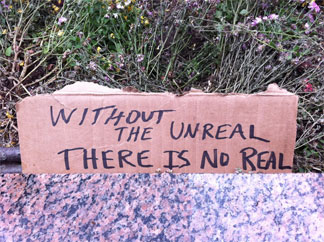
I have other versions, or readings, or riff-readings on what remix MAY be for the contemporary artist – and here the word artist too is fluid, but tends to relate best to my sense of the practice-based researcher who integrates images, sounds, texts, codes, and various social media practices and performance in the digital fields of a distribution. For example, in my collection of artist writings, META/DATA, published by MIT over four years ago, I not only go so far as to say that we are all BORN remixers, but that thanks to the proprioceptive qualities of the body and its nervous connectivity to the brain, we are biologically wired to unconsciously generate all kinds of remixes as can be seen in the way we unconsciously manipulate the data of everyday life through dreams, memories, and imaginative bursts of live, performative creativity – and that an applied remixology, if it is to have a pronounced effect on the revolution of everyday life, must – out of necessity – create a new state of active consciousness that programmatologically investigates the relationship between the real and the unreal – for, as my dear friend, the late great postmodern impresario Ronald Sukenick once said – and I quote him this in remixthebook – "Without the Unreal, there is no real."

Sukenick also once wrote, in one of his manifestos, that you need to "use your imagination or someone else will use it for you." In remixthebook I alter that simply into "Remix your life or someone else will remix it for you."

I also just a few days ago tweeted a remixed version of remixology that I mashed up with Jarry's pataphysics where I wrote "Remixology...will measure the exttent to which everyone is stuck in the rut of individuality."

I tell you this not just for the sake of being clever, but to suggest that even these terms we employ when riff-reading are nothing but more source material and their usefulness can be measured by how supple they become to our remixological touch as we rhetorically situate our creative practices into the flow of everyday life.

This is what artists do. It is what they do as they seek their way out to clearing. The impulse to create, it ends up, is mediumistic or, what in the remixthebook I term metamediumystic. The book actually opens with a quote from Duchamp's 1957 lecture in Houston, Texas, entitled "The Creative Act." In this very short presentation (which you can listen to at ubu.com), Duchamp says:
If we give the attributes of a medium to the artist, we must then deny him the state of consciousness on the esthetic plane about what he is doing or why he is doing it. All his decisions in the artistic execution of the work rest with pure intuition and cannot be translated into a self-analysis, spoken or written, or even thought out.
And there, on page one of remixthebook, I take this Duchamp quote and remix it which, I should note, I had already remixed on my Professor VJ blog three years earlier:
If we are all artist-mediums, we must then accept the fact that we are all in perpetual postproduction and that our aesthetic fitness relies on our ability to trigger novelty out of our unconscious creative potential. All of the decisions we make while performing our ongoing work of postproduction art rest with pure intuition and are envisioned as part of the creative act.
If you think about it, the source material we intuitively select and the way we remix it into our ongoing construction of what we used to call identity but may really be something more like the social media presence of an artistic medium perpetually postproducing their lives in the networked and mobile space of flows, is what it means to creative – and if we are both OF our time and AHEAD of our time – may also signal what it means to be avant-garde. Which leads me to wonder: if we are all born remixers who are simultaneously OF our time and AHEAD of our time as we participate in these acts of perpetual postproduction, then are we not also born avant-garde and, if so, if that's our biological imperative, then how does that relate to the globally distributed networks of social, economic, and political upheaval that are soundly rejecting whatever it is that is trying to kill the impulse that triggers these life-affirming creative acts – these always live, postproduction sets that naturally born remix artists hope to remixologically inhabit as part a larger creative class struggle to survive in turbo-charged, technocapitalist culture?

In remixthebook, I suggest that we may want to turn to remixology as the core principle of novelty – and here I am remixing Alfred North Whitehead who introduces the term Creativity into the philosophical lexicon in his book Process and Reality – where he writes that "Creativity is the principle of novelty" and that via acts of "concrescent prehension" we are biologically wired to experience "the production of novel togetherness."

What does it take for networked scenes of artists who employ strategic remix methodologies to produce [or, in my version – perpetually postproduce] novel togetherness? How would we want to start measuring the value of the aesthetic traces remix artists leave while proactively navigating our practices through these anti-disciplinary spaces we happen to occupy-when-making [and here the terminology is intentionally loaded – "anti-disciplinary" suggesting a mashup of anti-authoritarian and interdisciplinary – and the idea of "occupying" as remixologically inhabiting -- something absolutely connected to the global occupy performances that were initially started by the magazine collective associated with Adbusters, a culture jamming remix crew if ever there was one].

But even as we may want to make the connection between the way we think and dream and write and speak and remixologically inhabit or creatively occupy abstraction as part of an ongoing remixological process, we can also acknowledge that something else is in the mix, something that was barely present in mainstream life even fifteen years ago and that has become more pervasive and embedded in the practice of everyday life like never before, something that has turned everything we do on its head and that has challenged us to innovate the ways we communicate with each other, the ways we make art, the ways we write, the ways we perform our work in the fields of distribution that are available at our fingertips so that we can quite literally (and literarily) become these "intuitive mediums" that Duchamp refers to in his 1957 speech in Houston […] and here, of course, I am referring to the networked and mobile media communications systems that many of us are now – shall I say-- addicted to? – co-dependent upon? – or how about: using to our creative / economic advantage? I'm talking about the Internet, smart phones, and the collaborative forms of social media network performance – what I sometimes refer to as social media performance art practice – which to me becomes an ongoing, nomadic blur of intuitively generated, postproduction styles that are simultaneously and continuously being remixed in various digital editing environments that I port my transmedia narratives through (and I will speak more on transmedia narrative soon).

So let's just run with this a bit: according to the latest version of contemporary remix art theory being generated in remixthebook, we are all born remixers and know that to be the case just through our ability to constantly process reality as intuitive / remixological mediums who autohallucinate while dreaming or who, through daydream postproduction methods manipulate memory and creatively visualize the future present, all the while tweaking our intuitively generated aesthetic filters that we program ourselves to apply so that we can design our creative lifestyle practices with the ever-shifting contexts we perform our postproduction sets in […] (Sukenick: "use your imagination or someone else will use it for you") – and along with this more general and user-friendly concept of remix or remixology that I am opening up to everyone who consciously and/or unconsciously manipulates the data of everyday life as a way to perform in the digital culture, there are these networked and mobile media communication systems and protocols that many of us are intimately attached to (maybe that's better than "addicted to" – let's just say "intimately attached to"), and – something else to throw into the mix now – this is all happening during a time of global crisis because, whether we wish to acknowledge it or not, we are living in a time of radical social, political, economic and technological upheaval. Some might even suggest that the convergence of these factors, technological and biological in the sense that creativity and remixology are embedded socio-psycho-biological processes – is what's DRIVING of a lot of this upheaval. Could it be that to "occupy" as a "movement" is to collectively network social mediums performing on behalf of Creativity so that it [Creativity – or what I am terming remixology] may survive, so that WE – the embodied agents of creativity -- may survive far into the future.

Now, I am not here to lecture on the contemporary state of global politics and the crisis in Wall Street crony capitalism, although as a remix artist, it does provide some source material for my work, as do other politically hot historical events.
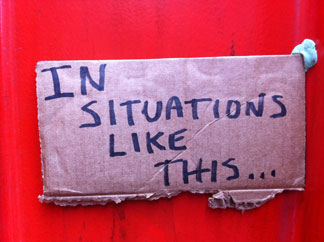


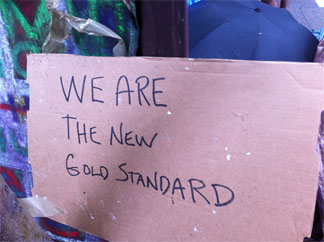
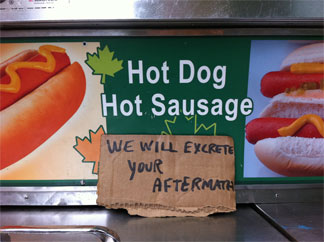
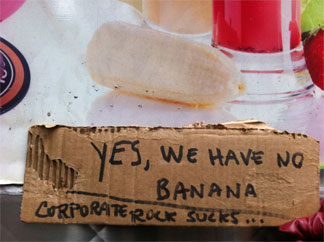
This is an image from a recent social media / conceptual art performance I conducted at Occupy Wall Street down at Liberty Plaza in downtown Manhattan, the seemingly geographical center of the #ows action.

But is there really a geographical center?

McKenzie Wark, who has just published a book, The Beach Beneath the Street, with Verso, and that's about the Situationist movements, writes in a blog entry at the Verso web site that the occupation isn't really about Wall Street since "Wall Street" is an abstraction, and as such, represents pr symbolizes a kind of inhuman power exerted by our new robot overlords only these freaks did not come to Planet Earth from Outer Space and are, in fact, man made. The question Wark asks is, "How do we occupy an abstraction?" One way is to physically be there. But another way, the way that this occupation is spreading like wildfire is, of course, by occupying what Wark calls "social media vector." An occupation, Wark writes, is the opposite of a movement:
[…] a movement aims for some internal consistency within itself but uses space just as a space to park its ranks. An occupation, on the other hand, has no internal consistency in its ranks but chooses meaningful spaces that have significant resonance into the abstract terrain of symbolic geography
.What happens when the applied remixologist enters the abstract terrain of symbolic geography?

Here are a few other images to get a feel for the performance:
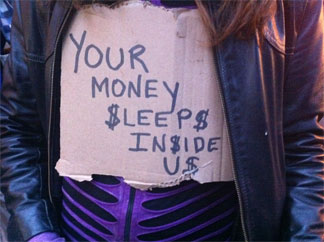


Here's a story about the applied remixologist entering the abstract terrain of symbolic geography that you might find interesting:

In 2002, Paul Miller aka DJ Spooky That Subliminal Kid and I were at the high summit Aspen Institute in Colorado for an elaborate program on Art, Science and Spirituality and when we drove back to Boulder so he could visit my with class, he passed on a VHS copy of Situationist Guy Debord's film Society of the Spectacle" [at this point in time, there was no YouTube to view it on nor was there a boomlet of interest in Debord's work so that it was easily accessible via a DVD box set].

My remix crew in Boulder, DJ RABBI (Rick Silva as Cuechamp, Trace Reddell as pHarmanaut, and myself as Kid Hasid), decided to create a digital remix of Society of the Spectacle. We used Google image search inserting words and phrases from Debord's SOS text – itself a plagiarized mashup of thoughts from diverse sources like Marx and Count de Lautréamont -- who once wrote that "Playgiarism is necessary. Progress implies it" – and from these Google searches we generated all of our visual source material to remix with Debord's own found footage, and applied other remix methods to create the audio and subtitles. This happened just a year or so after 9//11 and I think you'll see how the security state and oligarchy that drove all of the political rhetoric of that time becomes the filter for this specific work. Let's look at about the first half of the remix, a five minute clip.

[show SOS]

So, to reiterate this point just for the sake of clarity, this clip you just viewed is from a work of remix art that is at first triggered by the literal "handing off" or passing on or redistribution of source material – the redistribution of source material wealth for those of us who find value in such things -- and that this trigger – or what in remixthebook -- the Beatnik writer Leroi Jones refers to as a trigger-inference – this trigger-inference is really an embedded social gesture, and this social gesture – the transfer of the source from one artist to another – then leads to the development of experimental and collaborative investigation into "ways of filtering" (and here I am remixing Jon Berger's idea of "ways of seeing"] -- investigating "ways of filtering" common source material as well as delivering this postproduced source material via emergent exhibition contexts in the field of distribution. For this piece, the filters were decidedly politicized and informed by the security state and its conceptual use of terror as a fear trigger as well as a complete collapse of the objective media apparatus that was remixing the conceptual language art of the security state to further its own corporate agenda that it would later mash up in conjunction with Wall Street's Big Financial Crisis.

Now, my work is not always using contemporary politics and/or the whims of the traditional media apparatus as primary source material for socially relevant, aesthetic effect. In fact, if we fast forward about three years after the release of the SOS digital remix, we'll see that my research continues this desire to experiment with "ways of filtering" and investigating different exhibition contexts in the field of distribution in a very different way with my work Immobilité and its unintentional relationship to what some refer to as transmedia narrative.

So I am slightly shifting gears here.

Before I briefly discuss Immobilité and show you some aspects of its eventual production and postproduction, perhaps we should ask ourselves what is transmedia narrative and what value does it have for contemporary artists? The traditional art and entertainment industries would have us believe that transmedia is a powerful marketing concept that uses new media technologies to aggregate fragmented audiences by delivering story information across multiple media platforms. [an early example of this would have been the novice website for the film Donnie Darko but also the various transmedia elements produced in conjunction with films like The Matrix or even Avatar]

But as a remix artist who is investigating these "ways of filtering" and who experiments with his conceptual language art practice in the fields of digital distribution as well as in relation to social media performance, I am hoping to – if you will – reclaim the term "transmedia narrative" for my own uses as I try to imagine how fragmented stories being told by amateur-auteurs resist what the commercially minded academics call "convergence." In fact, the idea of convergence doesn't really match up well when discussed in relation to audience or even story fragmentation. It's part of a very old-fashioned modernist agenda that gets theorized by industry-friendly academics where we are asked to buy into the idea that everything will magically come together in this technologically sophisticated utopia. To me, this seems so anachronistic given how distributed and personalized social media networking feels to me (think Hakim Bey's Temporary Autonomous Zones) especially in these times of faux prosperity and real-world, dystopian financial ruin. It is my hope that new media artists, many of whom identify with the historical avant-garde, can now expand the forms of transmedia narrative to foreground this anti-disciplinary approach to encompass both contemporary practice and theory.

Immobilite, is, among other things, an accidental transmedia narrative, one that I composed as part of my hybridized remix / social media art practice. In the summer of 2007, I was invited to be a visiting professor and artist-in-residence at the University College Falmouth in Cornwall, the beautiful, you might say wild, southwest region of the UK. This is a location where we not have access to gorgeous country roads or even luscious hideaway coves but immensely dramatic cliffs overlooking the Atlantic Ocean as well as quite good surfing beaches.

When my Cornish hosts asked me from afar what I would like to do when I got there, I wrote back that I wanted to improvise and remix a feature-length "foreign film" shot entirely on mobile phone. This was 2007 and mobile phone video recording technology, though not high-def, was about to take a dramatic leap. And this idea of a "foreign film" as part of a new series of works is related to what Atom Egoyan once wrote. In the introduction to a book titled "Subtitles," Egoyan writes that "Every film is a foreign film." This concept of the "foreign film" relates to my initial impulse to mashup the DIY amateurism of mobile phone video performers playing with the aesthetics of YouTube styled vernacular video with the predominantly European art-house auteur cinema that as an undergraduate film student at UCLA radically altered my vision of the world. My sense was that this was an area ripe for discovery.

In the US, we call films from other countries "foreign films." When I was a teenager, watching foreign films, which none of my friends wanted to do, changed who I was. It turned me on to this alternative way of processing narrative. First of all, since I only spoke English, I had to READ the films every step of the way. This means that my favorite films, the ones that changed my life, are always films that I have had to read. But by reading, I am operating on many different conscious, subconscious and/or unconscious levels, because I am also seeing and listening and even moving too. I'm filtering. For me, movies, or motion pictures, have always been about moving, the art of riding with or ON someone else's rhythm, and learning to process those rhythms and layer them or remix them into my own ever-shifting rhythms. In remixthebook, I refer to this process of embodying rhythms as moving-remixing and I must say, sampling and remixing foreign movements have completely altered both my style and my life's story. Moving with Antonioni is different than moving with Bergman is different than moving with Marker is different than moving with Varda is different than moving with Cassavettes. And here is where I really disturb the commercial theories and premises of so-called transmedia narrative: for me, this moving-remixing of different rhythms – these always-live postproduction sets I am always intersubjectively navigating while reading other narratives – is what informs the ongoing distribution of my own transmedia narrative over the networked and mobile media environments I circulate in, and so the phrase "foreign film" can now, for me, be applied to much more than film per se. I can apply it to this investigation of -- for example -- choreographing the way we mobilize our states of presence over the network (and if were to put a footnote here, which I'm not, but if I were to put a footnote here I would also reference the concept of "choragraphy" in relation to the internet theories of Gregory Ulmer who tells us that "choragraphy" is a state of mind, or a state of "anticipatory consciousness" where invention takes place – and here I am reminded of Mallarme's notion of nothing having taken place but the place [itself] – this is like saying that nothing will have been remixed but the remix process itself, except in this case, and throughout remixthebook, we find that it's the unconscious readiness potential of the postproduction artist who creates novel forms of togetherness that ultimately triggers this performative gesture).

While in Cornwall, the cast and crew would magically convene via a localized social networking scene and the time limit for research and production was something like five-six weeks. Kate Southworth and the team she directed in iRES, the Interactive Art and Design Research Cluster, were incredibly generous and agreed to my proposition. A then brand new, just released Nokia N95 mobile phone with a first generation mobile-phone ready Carl Weiss lens and something like video recording technology was purchased and waiting for me upon my arrival. Once I was there, I was on literally location and in production.

But this is where I want to get a little philosophical with you and suggest that being "in production" is a ruse because, in fact, we are all always already "in postproduction." The digitally born avant-garde remixer is ALWAYS in postproduction. In fact, they must – out of necessity – acquire an elaborate skills-set focused at the interface of electracy [electricity and literacy) – so that they may constantly manipulate the data of everyday life as a way to creatively struggle through their ongoing transmedia narrative AS a work-in-progress distributed across the networked and mobile media environments their social practice unfolds in. For me, this is what being creative is becoming all about (becoming all about). It's something embedded in our unconscious readiness potential – and by that I mean it's something that is quite naturally triggered when we find ourselves caught in the heat of the creative moment – the simultaneous and continuous fusion of moments that comprise the artfulness of what it means to always be in postproduction, to become an intuitive medium engaged with digital media while caught in the heat of the creative act.

To give you a behind-the-scenes idea of what it's like to make an artwork like Immobilité, let me start by saying that Immobilité self-consciously remixes the rhythms and styles of European art-house directors such as Bergman, Antonioni, Varda, Cassavettes, Marker, and Ackerman, but also the underground film work of artists like Andy Warhol, Carolee Schneeman, Stan Brakhage, Maya Deren, and others [and here it should be noted that during our making of the work, in the summer of 2007, one very late night that went into early morning, we found out that both Bergman and Antonioni died on the same day, and this unquestionable fact also fed into our collective and collaborative conversations and mood as we continued socializing the project as an always in-process performance art event] . What would these deaths do to us? How would they tweak our collective social filters as we collaboratively postproduced our feelings while making the "foreign film"?

Now, as an artwork, Immobilité remixes other media besides film. The work not only remixes the stylistic tendencies or rhythms of filmmakers. As I mentioned, the work was shot on location in Cornwall and the wild and beachy landscapes appear throughout. I shot the scenes with this early version of mobile phone video recording technology [the Nokia N95] and really wanted to see what was possible regarding experimental hand-held techniques and very self-consciously used this small device that I could hold in the palm of my hand as a kind of lens-brush, if you will, one that I could manipulate through all kinds of hand-held gestural moves that I would improvisationally choreograph with the actor-players as part of our collaborative spatial and social practice, something that's hard to explain, but that involves building a small network of actors and crew members who basically just hang out together and make the work by sharing their stories, their books, their websites, their music, their food, and their movement through the project as it develops. [I'm sure many low-budget independent films and underground art rock bands have created new work in this kind of environment as well].

The look and feel of many of the experimental landscape shots are absolutely informed by the painterly rhythms of the post-World War II British Abstract Expressionists who, for the most part, resided in Cornwall, along with Surrealist refugees from the European continent who were themselves escaping their war-torn countries but were also, like all artists who eventually come to learn once they live in Cornwall, are dramatically effected by the light. It ends up the lineage of painterly light artists, from the naïve fishermen of the late 19th century, to the British Abstract Expressionists and temporary Surrealist residents, directly inform many of the abstract landscape imagery found throughout Immobilité. And then there is all of the writerly remixes as well, and here I specifically mean the subtitles, 90% of which are sampled and remixed from other films, novels, poems, and philosophical tracts that were circulating within our social network during the making of the film.

[Show remixes from Immobilité]

So what you just saw are remixes of the the 78-minute, limited edition, feature-length "foreign film." As an aside, I would encourage those who are patient enough to experience these kinds of time-based media works – works that experiment with, among other things, duration, repetition, looping, remixing, and altered states of mind or what I think of as dérive-styled or drifting narratives -- to see it from the beginning to end. It had its premiere exhibition at the Chelsea Art Museum in New York and was included in my comprehensive retrospective titled UNREALTIME at the National Museum of Contemporary Art in Athens, Greece. It has also been exhibited in the Fuse Box at the Denver Art Museum, the Seminario of Cinema and AudioVisual in Salvador, the arte.mov festival throughout parts of Brazil, and other venues.

While shooting Immobilité, I developed an improvised, formally experimental strategy of playing against the mobile phone video camera, of outwitting it, of smuggling human intentions into its program, to force the camera to create the unpredictable, the improbable, the informative, and to in many ways show contempt for the phone-as-camera and in so doing reject photography and videography as set formats but to also immediately fall in love with the freedom it gave me to ramp-up my nomadic art-making machine. [These last phrases are all sampled and remixed from Flusser as well.]

But there are other iterations of the Immobilité project too, versions of the work that have appeared in different contexts and in different formats and that have worked against the traditional distribution apparatuses that have enabled the story itself, the story of Immobilité as an art project, to experimentally circulate within the networked fields of distribution.

Looking back, we might say that Immobilité was unconsciously created as an alternative form of what the movie industry now calls transmedia narrative, but one that plays more with social media practices as a way to create intimate relations among the co-conspirators who make it and that does not have to present itself to the corporate entertainment industry as part of an elaborate commercial strategy designed to monetize the fragmentation of audiences.

In a recent dialogue in Portland, where I spend part of the summer, film producer Christine Vachon said that she was focused on being both length-agnostic and format-agnostic. I couldn't agree with her more. Her basic point was that the most important thing is to create the artwork of your time in whatever media formats and genres were open to receiving your creative energy. Once you accept this as the way it is then, all of a sudden, what I am calling spatial practice or the desire to continually tap into one's unconscious creative potential and let the language speak itself, becomes an incredibly vibrant force in REMIXING a life, and in remixing a life, opening oneself up to a social media -- or what we used to call net art -- practice that you can then turn into a nomadic art-making machine which, for me, is another way of phrasing transmedia narrative.

When I say you can turn your ongoing social media practice, with all necessary iPhone or Android accoutrements, into a nomadic art-making machine, what I am really saying is that we are now positioning ourselves to begin investigating the relationship between mobility and immobility, taking pictures and capturing data, and immersing ourselves in a multitude of digital editing environments while transforming ourselves into postproduction mediums who transmit "persona as shareware" [a lovely idea I have sampled from Paul Miller].

Persona as shareware. Or what I like to think of as digital personae as shareware circulating in the networked fields of distribution.

The visual artist Eleanor Antin once said in relation to her prolific practice: "I had a marvelous art-making machine: my personas. I never knew where it would go."

This also relates to the strange tension between the moving image and the mobile image and the emergence of the post-Duchampian artist-medium as nomadic art-making machine. As mobile medium circulating in the networked space of flows.

Let me now show you a few clips of the Immobilité remixes being projected in urban screen environments.

[Show clips of Immobilité on urban screens in Milan and Bucharest]

Is this too not a kind of transmedia narrative?

Think of how the mobile image has transgressed its normal boundaries.

It starts as a gesture where the medium, the artist, the hacker, unconsciously choreographs movement while circulating in the networked space of flow [that is to say, becomes electracy or a chora-graphic performer), holding on to the mobile phone as a data capturing device, but more than that, as part of a prosthetic-aesthetic, an intuitive gesture that meshes with the muscle memory I associate with proprioception --- that is, in the case of the phone, where you hold your eyes in the palm of your hand, and begin performing what dancers sometimes refer to as structured improvisation, capturing data as you slide between proprioception and machinic-vision. This is what it is was like for me shooting "on location" in Cornwall.

These moving gestures capture the data on to the mobile device and then it gets imported into the laptop where it then gets filtered through all kinds of digital editing environments, and one of the outcomes, in addition to the 78 minute version translated into different languages, is a series of remixes that appear on the Web. A curator then downloads those remixes and arranges for them to be projected in urban spaces, like the ones we just saw, and then a web cam captures the images live in the urban setting as part of a datastream over the Internet which I am simultaneously recording using image-capturing software on my laptop as I watch it in some other part of the world, and which I am now, a couple of years later, projecting in a room in Melbourne [Rio, New York, Denver, Istanbul, Sydney, Tokyo, ___].

This is when the moving image becomes a mobile image and the more we can learn from what this may indicate as an outcome of social media practice, perhaps the more we may begin to expand our concept of what it means to construct our lives as a fictionally generated transmedia narrative.

In this case, the remixologically generated transmedia narrative is partly about how the moving image becomes subsumed by the mobile image, how the moving image itself BECOMES mobile just like remix artists are now becoming networked and mobile mediums investigating the emerging forms of creativity.


Keywords: Mark Amerika, keynote, Rio, Melbourne, remixthebook, remixology, Immobilité, #ows

Wednesday, December 09, 2009

Extended Play Remix

It looks like I'm ending the year the same way I started it, i.e. with another peer-reviewed artist writing published in an international journal devoted to network cultures. Here's the feed from Fibreculture:
The Fibreculture Journal is affiliated with the Open Humanities Press - http://openhumanitiespress.org/

The Fibreculture Journal is a peer reviewed international journal that encourages critical and speculative interventions in the debate and discussions concerning information and communication technologies and their policy frameworks, network cultures and their informational logic, new media forms and their deployment, and the possibilities of socio-technical invention and sustainability. The Fibreculture Journal encourages submissions that extend research into critical and investigative networked theories, knowledges and practices.

---

What Now? : The Imprecise and Disagreeable Aesthetics of Remix

http://journal.fibreculture.org/issue15/

Issue Editors: Darren Tofts (Swinburne University of Technology,Melbourne) and Christian McCrea (Swinburne University of Technology,Melbourne)

Articles

The Renewable Tradition (Extended Play Remix)
Mark Amerika
http://journal.fibreculture.org/issue15/issue15_amerika.html

Cultural Modulation and The Zero Originality Clause of Remix Culture in Australian Contemporary Art
Ross Rudesch Harley
http://journal.fibreculture.org/issue15/issue15_harley.html

How can you be found when no-one knows that you are missing?
Lisa Gye
http://journal.fibreculture.org/issue15/issue15_gye.html

Sputnik Baby
Ian Haig
http://journal.fibreculture.org/issue15/issue15_haig.html

James Brown, Sample Culture and the Permanent Distance of Glory
Steve Jones
http://journal.fibreculture.org/issue15/issue15_jones.html

Materialities of Law: Celebrity Production and the Public Domain
Esther Milne
http://journal.fibreculture.org/issue15/issue15_milne.html

Materiality of a Simulation: Scratch Reading Machine, 1931
Craig Saper
http://journal.fibreculture.org/issue15/issue15_saper.html
This publication perfectly book-ends the year which started with the publication of Source Material Everywhere: The Alfred North Whitehead Remix in the special "Pirate Philosophy" issue of Culture Machine, another high-brow international peer-reviewed journal that is part of the Open Humanities Press. I say high-brow because to think these thoughts and to unravel them as part of an ongoing narrative that positions itself at the uncategorizable writing space where fiction meets memoir meets creative nonfiction meets theory is not the easiest thing in the world to either write or read. But it's the only way I know how to live (writing is surviving). For example, the Source Material Everywhere concept evolved out of nowhere while hyperimprovisationally blogging a few new riffs on remixology in relation to the process theory of Whitehead. These initial "discoveries" (unconsciously projected deep interior shots captured in asynchronous realtime) took place exactly two years ago in Hawaii. Those initial blog riffs then fed into the Culture Machine article which was then remixed into a few seminar sessions in my Remix Culture course. These ideas then got transcoded into some of the narrative material i.e. storyline (if you can call it that) that I finally unfinished as part of my feature-length mobile phone art film, Immobilité, which then fed into my thinking through more general issues relating to contemporary media arts practice that I waxed (poetically?) on in the Rhizome interview.

Make no mistake about it: to remix is to become. It's the only way creatures who perform the role of "postproduction medium" can survive in an age of aesthetics.


Metadata: , , , , ,

Tuesday, March 05, 2013

Micro-Cinematic Essays... On Exhibit @calit2 in San Diego

On January 17, 2013, Micro-Cinematic Essays on the Life and Work of Marcel Duchamp dba Conceptual Parts, Ink opened as part of the Three Junctures of Remix exhibition at the @calit2 gallery at UCSD in San Diego. The exhibition runs through March 15, 2013 and is curated by Eduardo Navas.

According to Navas, "The exhibition THREE JUNCTURES OF REMIX features the art of Mark Amerika & Chad Mossholder, Arcángel Constantini, Giselle Beiguelman, and Elisa Kreisinger, a group of international artists who have explored and reflected on the implications of the creative act of remixing since the concept became popular beginning in the nineties. The art works crossover and explore three junctures (moments of production) of remix: the pre-digital/analog; the digital; and the post-digital which developed in chronological order, but after their initial manifestation, became intertwined and currently are often reintroduced in conjunction to inform the aesthetics of remix as a creative act in art practice. The exhibition is curated to reflect on how computing has enabled people to recombine pre-existing material with unprecedented efficiency that is relatively affordable just about everywhere information-based technology is widely used. This has affected how local and global communities view their cultural production, from politics to the arts."

Micro-Cinematic Essays on the Life and Work of Marcel Duchamp dba Conceptual Parts, Ink is a collaborative "conceptual art" album featuring my own writing and vocals (much of it recorded using my iPhone Voice Memo app) and the sound design of electronic music composer Chad Mossholder. The work consists of nineteen experimental tracks that we refer to as "close readings" focusing on the work, language, and notes of Marcel Duchamp as well as his influence on contemporary forms of remix practice. Many of the tracks actually remix my own voice with the voice of Duchamp. An exploration into glitch, microtonality, and the spectral analysis of recorded voices over time, Chad and I surgically alter the aesthetic frequency of what is often referred to as "the artist's voice" and, in the process, invite the listener to rethink the interrelationship between critical writing and critical listening.

The work is now available in limited edition either through our Bandcamp site or by contacting the artists directly.

Keywords: calit2, SDSU, Three Junctures of Remix, Mark Amerika, Marcel Duchamp, Chad Mossholder, remix, Symbolic Sound, kyma

Wednesday, May 25, 2011

Video Book Trailer for remixthebook


The video above is an experimental "book trailer" that plays with source material from my forthcoming book of new media art / remix theory.

The book, now available for order here, is being published by the University of Minnesota Press.

Here's what the YouTube site says:

A provocative textual performance that is at once a dazzling model of the literary remix and a state-of-the-art reflection on remix culture, REMIXTHEBOOK captures the unique and continually shifting digital moment in which we live and situates the remix as an art form and literary intervention. To coincide with the publication of REMIXTHEBOOK, Amerika will launch a companion website, remixthebook.com, to facilitate new ways of participating in remix culture by inviting other artists and writers to create remixthebook mashups of their own, pushing the boundaries of art and literary culture further, beyond the current publishing paradigms.

Video Remix: Rick Silva
Audio: Chad Mossholder
Micro-Cam Footage: Mark McCoin
Voice: Mark Amerika

"Think of remixthebook as DJ Tool made from rhythms downloaded, ripped, mixed, spliced, diced, and burned into our collective hard drives, then re-uploaded. It's a piece of conceptual hardware that exists somewhere between how we experience information and how information aesthetics has transformed the human condition. It's that deep."
—Paul D. Miller aka DJ Spooky, That Subliminal Kid


Keywords: Mark Amerika, remixthebook, remix, mashup, DJ Spooky, University of Minnesota, theory

Wednesday, May 09, 2007

"ILLOGIC OF SENSE: THE GREGORY L. ULMER REMIX"

As both the publisher of this important new ebook as well as contemporary post-production artist heavily influenced by the work of Gregory L. Ulmer, I can't tell you how totally psyched I am to make this announcement. Please spread the word (of mouth, of mouse) on this one. Besides, it's available for free download!

ALT-X PRESS LAUNCHES "ILLOGIC OF SENSE: THE GREGORY L. ULMER REMIX" AS THE LATEST ADDITION TO ITS INFLUENTIAL EBOOK SERIES

BOULDER, Colorado, May 10, 2007 --The Alt-X Online Network, a space "where the digerati meet the literati" and on the Internet since 1993, announces the release of a new Alt-X Press ebook entitled "Illogic of Sense: The Gregory Ulmer Remix" edited by Darren Tofts and Lisa Gye, and designed by artist Joel Swanson of hippocrit.com.

Illogic of Sense: The Gregory L. Ulmer Remix
Edited by Darren Tofts and Lisa Gye
Design by Joel Swanson
http://www.altx.com/ebooks/ulmer.html

Contributors include Niall Lucy, Jon McKenzie, Linda Marie Walker, Craig Saper, Rowan Wilken, Marcel O'Gorman, Teri Hoskin, and Michael Jarrett, with an introduction by editors Tofts and Gye.

"Illogic of Sense: The Gregory L. Ulmer Remix" is an exciting new ebook publication that employs theorist Gregory Ulmer's invocation to invent new forms of electronic writing. As the ebook's editors, Darren Tofts and Lisa Gye, write in their brilliant introduction, "Ulmer has been at the forefront of thinking about new cultural formations as the paradigm of literacy converges with digital culture." Ulmer's work has been central to contemporary thinking on the future of writing and his international presence as one of the leading figures in media arts discourse has influenced a multitude of disciplines from electronic literature and Internet art to critical theory, communications studies, and art history. The ebook features a diverse group of artists, theorists, and creative writers who develop new forms of hybridized "digital rhetoric." Their inventive and audacious experiments take advantage of recent developments in the field of new media studies, and as part of Alt-X's mission to participate in the creative commons provided by the Web, are available for free download.

This provocative collection of multi-tracked writing puts into play many of Ulmer's breakthrough theories summed up in his most recognized hot-button terms: applied grammatology, heuretics, post(e)-pedagogy, textshop, mystory, and choragraphy. Encouraged by the example of Ulmer's own hyperrhetorical writing style, the authors incorporate collaged imagery, mp3 soundtracks, and QuickTime movies into their innovative multimedia mix while exploring how these same extensions of "writerly performance" explode the false barrier between academic discourse and spontaneous poetics, narrative and rhetoric, and autobiography and fiction. Positing an "illogic of sense" to reclaim what Ulmer calls an "anticipatory consciousness," designed to utilize the force of intuition as a way to invent emergent forms of knowledge, this grouping of hypermedia texts showcase how interdisciplinary writers can remix the methodological approach of an avant-garde philosophy propelled by Ulmer, one that prioritizes an ongoing process of discovery and media arts assemblage.

The ebook is beautifully designed by artist Joel Swanson of hippocrit.com, who crosses his visionary design sensibility with state of the art technology to produce an original work of ebook-art that many will view as finally fulfilling the long-promised potential of online publishing to use stimulating visual arrangement, media hybridization, and typographical ingenuity to blur the distinction between publication, exhibition, and design performance.

“Simultaneously celebrating and expanding on the writing performances located in Gregory Ulmer's rich oeuvre of totally remixable source material, the collection of essays in 'Illogic of Sense' adhere to an experiential approach to creative/critical writing and in so doing teach us how to write a theory of poetics that will help us invent a new field of study that I would call interdisciplinary digital humanities." - Mark Amerika, series editor, Alt-X Press; author of "META/DATA: A Digital Poetics" (MIT Press, 2007)

You can download "Illogic of Sense: The Gregory L. Ulmer Remix" ebook as well as other Alt-X ebooks for free at http://www.altx.com/ebooks/


Metadata: , , , , , , , , , ,

Tuesday, June 10, 2014

Locus Solus - Centenary Edition Auto-Translated by Mark Amerika

In this excerpt from my Schwab "Say Yes!" lecture at the University of North Carolina at Chapel Hill, I briefly digress into a story about the making of Locus Solus, my auto-translation / remix of Raymond Roussel's novel of the same. Roussel originally published his novel exactly 100 years ago in 1914. My version will come out with Counterpath Press later this year.


"What else am I going to be able to remix?"

For me, that question is not very different from, "What else am I going to make before I definitively unfinish myself?"

That phrase, definitively unfinish, is, of course, taken from Marcel Duchamp's encapsulation of the creative process as it related to his Large Glass, also known in English as The Bride Stripped Bare By Her Bachelors, Even, a work that was composed between 1915 and 1923. For the past few years, I have been meticulously remixing this source material from this significant work of 20th century art across different media platforms as part of my next large-scale transmedia narrative project, this one entitled Inside the Green Box, a reference to Duchamp’s textual accompaniment to the Large Glass titled The Green Box. At times, Duchamp referred to his Green Box as a book. He also referred to it as an album, one that he configured in conjunction with this elaborate work of art he meta-tagged a delay-in-glass (he also used the phrase delay-in-painting).

According to Duchamp, "one could not 'see' the painting without consulting the various elements found in the green box […] I wanted that album to go with the ‘Glass’, and to be consulted when seeing the ‘Glass’, because as I see it, it must not be ‘looked at’ in the aesthetic sense of the word. One must consult the book, and see the two together."

It's my sense that the Large Glass and its accompanying Green Box are already conjoined into what, today, we would call a kind of transmedia narrative, and my remix, Inside the Green Box, will hopefully be released some time next year. Aspects of my work have recently been released or will soon come out, including my novel-length auto-translation / remix of Raymond Roussel's Locus Solus which, first published in 1914, will soon be marking its 100 year anniversary. My remix of Roussel’s book will be published later this year and was composed by playfully postproducing the original 1914 version using a variety of mediocre online translation programs. Here’s the story behind this auto-translation / remix which I see not so much as a literal translation by any means, but as a work of performance art:

One night in early February of 2012, after an exhausting day at the County court, serving on a jury for a rather seedy, sibling sex abuse case, I distracted myself from the opening day’s events by conducting more research for this Inside the Green Box transmedia narrative I am developing, I came across an interview with Duchamp where he was asked what most influenced him while making the work and he said, "Roussel showed me the way."

Somewhere in the back of my mind I had recalled having read this quote in some other context but had never followed up on it. However, it was at this very moment of (re)discovery, while I was looking for a long distraction since I could not talk to anyone, not even my wife, about the sleazy court case I was now a jury member on, that I decided to pursue the link. In order to get a quick sense of Roussel’s work, I immediately started searching online for any of his work published in English translation. In the same interview quoted above, Duchamp had mentioned Roussel’s other by-now famous work, Impressions d’Afrique, as his primary influence, and that was the one I was looking for. Since I do not speak French, I was hoping to find a readymade PDF already translated into English that I could easily download. As it happens, there was no version of this work that I could find online. However, Locus Solus, the other one of his two most famous works, was available online in French and since I was impatient and wanted to access any Roussel I could get my hands on, I decided I would read this work instead. But there was still the issue I kept denying to myself throughout this entire process, namely that I do not read or understand French, let alone Roussel's version of it. What was I to do? I decided to get an immediate feel for Locus Solus by turning to a few mediocre online translation programs that would auto-translate the first few pages, line-by-line, and see what came up. But since I do not read or understand French, let alone Roussel's version of it, I decided to get an immediate feel for Locus Solus by auto-translating the first few pages, line-by-line, with a set of mediocre online translation programs. (author's note: just recently, an older translation of Locus Solus into English has just become available online - still, it makes no sense for me to read it now and I'll let others conduct a comparative media studies investigation if they so wish).

Needless to say, given Roussel's strange procedural writing style, the auto-translation was full of glitches and illegible strands of narrative thought. When I refer to Roussel's strange compositional methodology, I am referring to some of his personal theoretical writings that he had kept secret until his death and that were posthumously published in the volume How I Wrote Certain of My Books, where he describes his method as follows:

"I chose two similar words. For example billard (billiard) and pillard (looter). Then I added to it words similar but taken in two different directions, and I obtained two almost identical sentences thus. The two sentences found, it was a question of writing a tale which can start with the first and finish by the second. Amplifying the process then, I sought new words reporting itself to the word billiards, always to take them in a different direction than that which was presented first of all, and that provided me each time a creation moreover. The process evolved/moved and I was led to take an unspecified sentence, of which I drew from the images by dislocating it. . .”

Needless to say, my simple late-night plan to use a translation program to better understand Roussel’s writing and why it might have “shown Duchamp the way,” was immediately introduced to a severe obstacle as I tried to make some narrative sense out of the mangled text and mistranslated puns and double entedres that were given to me by the auto-translation program. My intuitive response was to not get frustrated at all but to creatively remix these mangled translations through my own experiential filters as valuable source material that would enable me to remixologically inhabit the spirit of Roussel’s own procedural aesthetic. This is when Roussel's Locus Solus started becoming a mash-up of auto-translation and autobiography or what in META/DATA I refer to as pseudo-autobiography (an always already fictional rendering of experiential data sampled from the practice of everyday life).

That first night, I started to really get into the auto-translation / remix process and decided that I did not want to buy and read any of the out-of-print books that had already attempted to translate Roussel into English, that, instead, I would approach this experience as a work of performance art and, like so many works of performance art, view it as a kind of durational achievement. And so it was, four months later, that I had translated / remixed the entire, mangled French version into what I started referring to as

Locus Solus (An Inappropriate Translation Composed in a 21st Century Manner)

All throughout the auto-translation/remix performance I was well aware of the fact that things were getting lost in the transmission, that the stability of the narrative trajectory, assuming I wanted to maintain a certain amount of stability and even semantic consistency, was going to depend on my ability to remixologically inhabit or even embody the praxis of another artist-medium who initially communicated these messages to us a long time ago (100 years to be exact). This was a creative parameter that actually liberated me from having to feel better about myself as I assumed the role of so-called "translator." Instead, I could approach the whole system as a literary traitor, one who pirates information signals and trades in a performance art practice that imposes their own literary and artistic traits onto the one who is being auto-translated, remixed, inhabited.

So to loop Duchamp back into the mix here today, particularly in reference to what his primary influences were while composing his major transmedia narrative, The Bride Stripped Bare by Her Bachelors, Even, "Roussel showed me the way."

Monday, October 24, 2011

Waves of Remix: MA in Sao Paulo Art Magazine SELECT

This article / interview in seLecT with the amazingly insightful Juliana Monachesi has been out for a little while, so now I am going to publish the English version of the Q&A that led to the article.

In addition to the well-researched and thoughtful questions posed by Juliana, the spread has my favorite 2011 picture by far and, it should be noted, I am not very vain when it comes to looking at images of myself (quite the opposite, really). But this image captures the spirit of my life (style /practice) since about 1999 when I first started regularly (post)producing new work in Hawaii :)


J: You have described the web as a “public domain narrative environment”, but people engage in this environment very differently and in various degrees of narrativity: how would you say the advent of this new world scenario has changed our narrative forms, be they fictional, historical or journalistic?

M: Yes, in 1997, almost fifteen years ago when I first released GRAMMATRON (grammatron.com), I was imagining a near-future world where online, role-playing personae used network technologies to teleport themselves into open source narrative environments. This was an intentional experiment in creating a pseudo-utopian speculative fiction that took William Gibson's notion of "cyberspace," one that he developed in novelistic forms, and expanded it into what then felt like the wide-open hypertextual spaces of the World Wide Web. I imagined these online, role-playing personae as artist-agents who created on-the-fly posthistorical narratives in the sense that Flusser uses the term. This meant that writing your story was not going to be about developing a setting, a character, or a plot, but would be more about performing an image of yourself in the social media network.

Back in the mid-late '90s, the idea was to create your multiple role-playing personae by linking them through different hypertextual spaces. Because things were less corporate back then, I was intentionally trying to produce a temporary or even semi-permanent autonomous zone for artists to collaboratively build their shared "storyworld" (we did this at Alt-X, now a living archive at altx.com). We still surf these hypertextual spaces today, but that's just one aspect of a more robust networked and mobile media arts practice. Things have changed dramatically in the last five to ten years. It's less about hypertext and more about embedding the mobile network into our daily rituals, or what Michel de Certeau, in a different context, referred to as the practice of everyday life. Net 2.0 artists, for example, are not trying to figure out the Internet, at least not the way the early Net artists had to spend so much time doing fifteen ago. Now you could say that we are all Net artists, or at the very least Internet-aware artists who remix multiple narrative threads via social, web, and mobile media systems. These are not traditional linear narratives. In electronic environments, our multiple and hybridized personae flow through various multi-linear, multi-dimensional, and super-atomized narrative streams, and they all run parallel to each other. Playing these roles comes naturally to The Artist 2.0. I do this too. For example, I role-play different personae on my Twitter stream @markamerika where I am at times an artist, a serious foodie, a poet, a professor, a comedian, and a beach philosopher (to name just a few).

J: I saw an excerpt of your work for the Montréal Biennial at CIAC’s electronic magazine. “Glitch” and “remix” are two of the concepts and aesthetics you keep rehabilitating through all your practices. In your opinion, is everything really and definitely just a version of something else?

M: Seriously, for me, it's not an opinion, it's just a fact of life. For those of us who create our lives out of what, in my new book [remixthebook.com], I call the Source Material Everywhere, we are always versioning the next manifestation of what it means to be an ever-morphing, digitally networked persona, what my friend Paul Miller [djspooky.com] refers to as "a cut-and-paste as-you-go" multiplex consciousness. This may seem unnecessarily "deep" but really, if you think about it, activating your Net presence means you have to start seeing your conceptual personae as shareware, something that lives in the social fields of distribution. For me, this is just life in the 2010s.

J: As a constantly touring VJ and constant VJ-theorist, how do you describe this art practice at the beginning of a new decade? In Brazil, even though there was a cutting-edge VJing scene mainly at the beginning of the 2000’s, it is sort of a no-scene nowadays (as with de DJ-boom, actually, that today is in the hands of pitch-and-sinc-accommodating-software-aided-iPod-celebrity-DJ’s…); how have things evolve elsewhere?

M: Believe me, I know what you mean about no-scenes. Just because you start a lot of scenes, and are lucky enough like I have been able to fall into and out of many different international scenes, does not mean you have to stay stuck in something forever. This is definitely true of VJ culture. I was heavily involved with my international VJ tour during the years 2000-2005. It was great because not only was I able to travel the world and remix my digital video artwork in front of live audiences, but it also informed what came after my VJ tours, which was a series of large-scale, digital video and surround sound installations in various museum spaces. The aesthetics of VJing is what most appealed to me when I started playing live gigs around the world. First, it enabled me to expand my remix practice into something like "live cinema" but even more importantly for me -- and to my surprise -- it also opened up my creative potential as a visual artist and I started rethinking the relationship of my work to the history of painting, especially abstract expressionist and color field work from the 20th century.

My feeling is that you have to keep moving, to change direction or else you will end up where you are heading. So I stopped VJing in 2005 although, like what happened when I stopped making hypertext and my early experiments in Net art, these practices still resonate with what I am doing today. Having spent a great deal of time working with multi-linear narratives, Net art, live A/V performance, experimental sound art, and postmodern novel writing, has really set the stage for my latest series of transmedia artworks like Immobilité (immobilite.com) and my new work in progress, The Museum of Glitch Aesthetics, a project co-commissioned by the Abandon Normal Devices festival in the UK in conjunction with the London 2012 Olympics, and hopefully the State of Bahia too.
 
J: Collage, appropriation, intertextuality, cover, remix, bootleg, sampling, mashup, assemblage, combine painting, recombination, remediation, pastiche, postmodernism, postproduction, avant-pop, bastard-pop… Is the century-old (and sort of peripheral until the 1990’s) art practice of collage finally the protagonist of art history? And whatever happened to creativity?
 
M: Creativity is in the mix! It's inseparable from remix practice. In fact, this is the core principle that I explore in remixthebook (remixthebook.com). The book opens with a remix of the process philosophy of Alfred North Whitehead who is generally considered the main philosopher, with the possible exception of Bergson, to really work the whole concept of creativity into a philosophical platform that reveals how we are all creative entities, creatures who intuitively generate new versions of life by continuously remixing the source material we find ourselves immersed in. The one Whitehead phrase that continually loops throughout remixthebook is "Creativity is the principle of novelty." What I do in the book is string together a connection between Whitehead's notion of creativity, and its relation to novelty, with what it means to be avant-garde (no longer a dirty word), and how being a remix artist who is always ahead of ones time is a kind of necessary condition if one hopes to visualize the next version of "creativity" coming.

So the protagonist of this historical trajectory is not practice-based collage per se, although I see where you are going with that, but the medium itself. In this case, the artist is the medium is the message. The creature as remixological animal.

J: I couldn’t find much on remixthebook, but cannot imagine it’s a theory book, considering the way you work – never dissociating fiction, theory, art and cyberpsychogeography. Is it too written in the form of “action scripting” and by many of your “flux personas” at the same time? Would you tell a bit about this project and how it differs from your other books and projects?

M: This is because I am doing things to theory that are very rarely done. I bastardize and/or compostproduce it so that it comes across as something other than academic theory. One of the main premises of remixthebook is that theory per se has been hijacked by the academic elite who spin their own jargon-laden remixes in very specific scholarly styles that try to shut out everyone else, even innovative theory-artists, so that they can maintain cultural authority over what is and is not considered preordained theory. But why try and maintain the theory status quo even as the world around us has gone through such radical changes and essentially challenges us to invent new forms of theoretical discourse that are relevant to the technological times we live in? Most of the academics who teach theory have, for some reason, chosen not to accept the challenge to reinvent theory for our time, and it's this cultural elitism that makes it impossible for them to maintain their cultural authority. Anyone who pays attention to what's happening, who is actively engaged with networked and mobile media communication technologies, and who reads and composes their own DIY forms of theoretical discourse, is quite naturally remixing theory back into their practice-based research (which is exactly where it belongs).

In the various versions of remixthebook that appear in both the print book and on the Web at remixthebook.com, what you get is the ongoing performance of theory as practice-based art research. The project samples more from artists like Allen Ginsberg, Nam June Paik, Kathy Acker, Ad Reinhardt, and Robert Rauschenberg -- or even comedians like George Carlin, Stephen Colbert and Steve Martin -- than, say, the tantalizing post-structuralists, although I do borrow from them too. I should also mention Vilém Flusser since, to my mind, he is a unique theoretical figure, a kind of fictional artist and media theorist hybrid. He once said that he viewed his media theory more like science fiction than media theory per se. In this regard, I see my own media theory more as avant-pop performance art.
 
J: Is it something of an in-depth research on the “space of engaging co-conspiracy” that you like to call “the world wide web as collectively self-generated collage remix machine”? Do you still see the web that way? Do you still design your Net art works acknowledging the participant a huge role? I mean, reading about your interest in long length movies, I tend to think that you somehow got frustrated or suspicious about the collaborative, crowd-sourcing art making process. Is that so?

M: This is a really good question because I would not want to leave anyone with the impression that I am or have been, for some reason, totally enamored of the concept of an "anything goes" participatory art, especially the kind that champions computer interactivity as some kind of "art form of the future." For me, participation is and always has been less about the user-generated content side of things and much more about the intimate social connectivity of people. When I make a work like Immobilité, it's very transmedia in its design, and so, yes, there is a longer, feature-length version of the work that has been exhibited internationally as a large scale installation, but it has also been remixed into other distribution, exhibition, reading, and screening contexts including large-scale public screenings, an iPhone app, various remixes playing on urban screens across all seven continents, an elaborate Web site with video and audio remixes, and a downloadable artist e-book, etc. For me, the making of the work is where the intimate participation, the social energy, manifests itself. It's really about the creative process, of making things intimately, among close collaborators or even people who I have never met but who are open to taking the shared source material and postproducing a version that is part of their own revolution of everyday life.

J: And would you tell a little about the site of remixthebook? Is it really the entire book remixed by other artists?

M: It's fantastic. Vernacular video as digital theory, e-book as conceptual art, Net art as performance writing. The artists and theorists are all amazing in their own right and what they are doing is remixing different chunks or excerpts of source material from the written text or my audio recordings reading the text remixes or even videos of me faux-lecturing the text as "course material," etc. There is also an entire section that we call The Course where the idea is to look at the history of collage, appropriation, literary cut-up, détournement, DJ/VJ and live audio visual sampling and remixing, activism, and what Nic Bourriaud calls postproduction art. The idea is to take what we used to think of as A Book, and recontextualize it for social media art and culture. This is not that unusual. The 19th century French poet Stéphane Mallarmé was trying to do something similar in his own intermedia way (Mallarmé: "Everything in the world exists in order to end up in a book." My remix: "Everything in the world is Readymade Source Material that exists so it can end up being remixed.") My hope is that students as well as random web visitors to the site will also remix the book.

Keywords: Mark Amerika, theory, select magazine, remixthebook, contemporary art practice, experimental writing, net art, détournement