art / remixology / politics / cinema / fiction / theory / performance / writing
Monday, July 30, 2007
Another Kind of Persona
Given how much this blog and my new book play with the concept of persona, it should come as no surprise that my current work in progress, Foreign Film (Immobilité), is partly influenced by Ingmar Bergman's classic film Persona. Bergman has just passed away at the age of 89:
The idea for "Persona" came to him after seeing his friend Andersson sunning next to Ullmann, a Norwegian actress who became Mr. Bergman's companion and muse for many years. Struck by the resemblance of the two actresses, Mr. Bergman decided "it would be wonderful to write something about two people who lose their identities in each other."
This idea of "two people who lose their identities in each other" is not exactly what happens in Immobilité, and there is actually an invisible, third persona that infects the narrative's movement. Also, there is more to Bergman's "Persona" narrative than "losing identity" and in my new work, what at first looks like "losing sight of oneself" becomes part of a longer process where one actually finds oneself (albeit as as a hauntological flux persona, that is, a simultaneous and continuous fusion of becoming marked by what one has already become).
In my second novel, Sexual Blood, the protagonist Mal (short for Maldoror but also Male), is identified on the first page as a figure who wants to "become woman." In GRAMMATRON, Cynthia becomes Ms. A and Abe Golam becomes too many others to even begin listing them all here. The cast of personas in PHON:E:ME (referred to as sonoluminiscent characters) are quick-change artists whose personalities seep into one another. Interesting to me is the fact that I only viewed Persona after having created these works.
Instead of multiple personality disorder in the traditional psychological interpretation of that term, a lot of the figures who appear in my work explore (and do not suffer from) Multiple Persona Becoming. Is it dangerous? This is what Bergman, in some of his films, investigated -- and so am I.
Bergman's "ascetic visuals, intense close-ups and limited dialogue" are hard not to be influenced by if your are at all interested in developing a more philosophically rendered and truly independent narrative art beyond cinema (and beyond "independent filmmaking" per se).
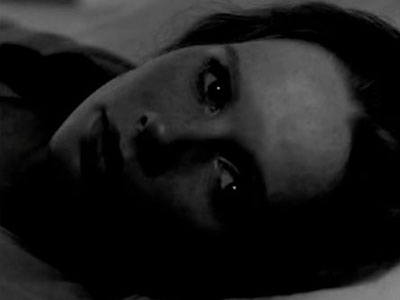
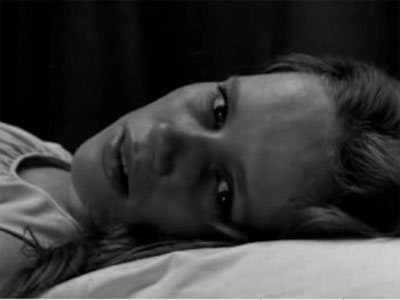
He once said:
The people in my films are exactly like myself [...] Mostly they're body, with a little hollow for the soul.
Of course, the emotional dramas he directed betray these rare self-interpretations and point toward a deeper interior conflict that sometimes only an image can portray. For real body personas minus the theatrical drama, we could turn to obliterature, especially the early nouveau roman work of my old teacher Alain Robbe-Grillet. Some of Robbe-Grillet's films, like L'Immortelle, investigated the imaginary "body persona" as hallucinated by L'Invisible. Metadata: philosophy, Ingmar Bergman, art, Persona, artists, Alain Robbe-Grillet, cinema, independent film, mobile phone
Who is this sexy bot that has me saying "Who" and not "What"?
It's like being thirteen and in love with an anime character who I just know knows me.
An incorporeal presence checking out the latest in high resolution skinz, she tries on a new persona just to lure any "me" into her demographic domain.
She wears this new skinz, this updated persona, quite well, but in actuality, never leaves the fitting room.
Well, it's really a dressing room, but now that she's feeling all robotic she's obsessed with fitting in.
But first she has to fit into her new persona.
How best to do that, especially since those of us who she attempts to seduce into her all-consuming realm of possibility automatically view her as an all-too-predictable spam-bot?
She decides, "This is who I am," and so: "I need to embrace it."
By embracing it, she fits the part perfectly, as if it were made for her.
Sexy spam-bot extraordinaire.
The persona becomes her.
She does more than just fit in. Now, she owns the room.
But for how long?
Just as I am about to totally second guess myself and commit to something that makes no sense at all but that would be a unique experiment in disembodied transference of vintage demon leakage into an abyss never quite deep enough, she flips the script and morphs into something completely different: a translucent goth chick who is all tattoo and no high-def skinz to speak of.
But then that gets old too, like three days old, and she goes all post-postmodern on me by unwittingly blocking herself from receiving any direct messages (from herself).
It's one of those elongated moments of mystical selflessness, as if she had taken her avatar presence and immersed in an anechoic chamber "until the end of the world."
When I finally hear back from her, it's a quick DM, terse, and to the point: "Why connect when I can just as easily deface myself?"
It's hard to explain what this DM does to me, especially given her track record in identity scalping.
(Besides, the Great Recession is still receding, except for the 14.6%, and there's no telling what her or anybody else's motives are for doing what they do).
Soon she clothes herself in yet another persona, makes a splashy appearance on various social media networks, and everyone gets all frantic reading something different into it.
What do I specifically read into it?
I am not "I," so it's really hard to say (at least I haven't blocked myself from receiving my own direct messages -- not yet).
But the more I find myself attracted to this sexy spam-bot who continually shares with me her readymade pornographic come-ons, the more I realize that something is fighting for its specific subjectivity, even as the data world continues to resist.
This data world is suffused with fate.
Marketing fate.
Demo(graphics) or Die.
OK, how not to succumb to everything the apparatus has to offer her? Can't she just take a long form creative pause?
No, she repeatedly accepts the offer and buys another persona. Another layer of high-def skinz.
This is her (marketing) fate.
She is convinced that this new persona is totally "for reals" (just like all of the other ones still to come, profusely).
Her whole aura is now singularly aesthetic in its appeal to the distributed network that she has successfully rekindled.
"They don't call it buying power for nothing," is what she confides to a robo-mate she's just friended.
(How many robo-mates is she auto-friending and who will defacebook her next? "This," she sends in a follow-up DM, "is Fear Factor incarnate.")
However she distributes her personae, the point is, she's positively reinforcing her ongoing relevance to whoever will follow her.
This summer's initial location shoots throughout Cornwall have produced a wealth of potential source material for various remixological projects that are now in postproduction. The Amerika/iRES connection started last summer when I met up with the entity known as VJ Theory who have just launched another D-I-Y project called VJam.
In an ongoing dialogue we are having and that will soon be published, this exchange takes place:
Ana: The Small Projects we organize on vjtheory.net, aim at creating collaborative theoretical works reflecting on VJing and realtime interactive practices. We are creating structures for people to come and write ‘artist theory’ as you describe it. Theory that is as creative as these practices. It is since we started to make these Small Projects that the entity has been changing. We are sometimes two (as D&G say in the introduction to A 1000 Plateaus) but sometimes we are a lot more. This identity changes in number. The time I (Ana) strongly felt this was at the Intercontinental chat organized by TEAS in Vancouver. We were doing a video chat with people there onsite and another one online with people from Europe, LA and Australia. The conversation was on the subject of ways to make possible collaborative writing and suddenly I felt we were all actually thinking as a single entity, proposing possibilities, as VJ Theory.
Something that I find common in our interests is the subject of the persona. Entities, collective individualities and the expansion of individuals into several personas (either with the use of pseudonyms or as something a lot more complex), all these are to my views constructions of fictional selves, which are a lot more real that a ‘linear’ self (if that exists at all). This blend of ‘digital flux personas’, as you call it, can be seen in every aspect of these practices; VJs come from many areas of knowledge (programming, design, philosophy, illustration, sound, writing, engineering, science, …) to meet and merge at a performative point. This is possibly what will increasingly drive current and future theoretical works.
What are your ideas on the future of the VJ as performer and persona? Will she, he or they be a theorist/reflective thinker as much as a practitioner? And are we closer to a point of convergence of philosophy and art?
Mark: Yes, as I suggest in META/DATA, the artist is the medium is the message. And yet this entity (as you call it), this persona, the artist-medium, is in flux and capable of multiple becomings. I was investigating the way artist-mediums conduct random acts of "multiple persona simultaneity" in my early novels too and then, after experimenting with new media technologies and ramping up my spontaneous artist theories, started bringing these ideas into VJ performance as well.
When writing the new section of the book, Spontaneous Theories, I found that the figure of the VJ was perfect for my philosophical investigations. In this way, the VJ I am compositing in my narrative, is not an eye-candy salesman at doof-doof club events. I do acknowledge these other kinds of VJs and like to go to clubs as much as anyone looking for a good time out in the social network, but the VJ I propose is more of a nomadic net artist who hyperimprovisationally taps into their readiness potential by triggering the neural mechanism that leads to unconscious creative activity. In this way, the VJ is more of a remixologist, someone who affectively mixes their memories, personal narratives, fantasies, and just-in-time autohallucinations into one string of events. This VJ I am conjuring up is part philosopher too, and is capable of rendering into vision a new kind of life style practice (LSP) that inmixes the Real with the Unreal and turns their live sets into a kind of performative dreambook composed of spontaneous situations made out of on-the-fly manipulated imagery. The performative aspect of the gig is to try and sync your in-flux persona(s) with the multiple and hybridized layers of meaning that you are capable of generating at a given stretch of time. You do this by quite literally becoming the rhythms your persona(s) embed in muscle memory.
It's like Miles Davis once said: "Sometimes you have to play a long time to be able to play like yourself."
This is a transcript of the screen/writing/play going on in the video:
But what about the Unreal?
With out the Unreal,
there is no Real.
His Moving Visual Thinking
Performs a narrative function.
This function is to improvise
a digital dreamwork always in process.
To become a theory-to-be.
Ad nauseum.
Add nausea.
Add museum.
[add musing...]
VJ Persona is an i.d. entity
forever in search of meaning
[add musing...]
He uses his hyperimprovisationally constructed
fictional memory as source material.
[add musing...]
This proactively constructed fictional memory
is performed as digital flux persona.
Does it happen in realtime?
Unrealtime?
U n r e a l time?
Without unrealtime,
there is no realtime.
How about timeless time?
Just-in-time?
For what?
The important thing is
to annihilate the important thing.
The important thing is a feeling.
The important thing is Losing Sight of Yourself
so you can find yourself again.
The important thing is to use experience
as base for knowledge-invention.
The important thing is to remix
digital flux persona.
The important thing is
to outthink premeditation.
The important thing is to proactively
situate the artificial intelligentsia
in the networked space of
performative flows
so as to prompt wild mutations of
bodily lust
just within reach of the collective unconscious...
...
...
...
...
...
The elliptical nomad,
VJ persona.
IN the images?
Are they bio-images?
Do these images actually think?
Do they hallucinate other images?
When I say “this is VJ Persona,
streaming my digital flux identity,”
who is the “I” and
who is the “my”?
Whose story is it?
Machinic story on
machinic time?
Machinima.
My Life As A First Person
Digital Flux Persona.
A VJ theory-to-be.
What You See Is What You Get.
What You Get Is Simultaneously
Cinematic and Pixilated.
What You Transgress
Is Video Art.
What You Pint Back To
Is Video Art.
What You Refrain From Repeating
Is Video Art.
What You Do IS
Change The Way You See.
What What You Steer Clear of
Is Conceptual Art.
What You Reinvent
Is Beauty As A Subliminal Force In Consciousness.
What You Avoid
Is Theorizing Your Practice To Death.
...
The concept of UNREALTIME has been permeating my work for about seven years now. It began seeping into my thinking with the blur-motion remix style of FILMTEXT, was articulated in my spontaneous artist theories in META/DATA, and will come to the foreground in my upcoming retrospective exhibition in Athens that includes the European premiere of Immobilité.
Three pix from the gig at the Korean Buddhist Research Institute in Seoul:
"Artist, Medium, Instrument" Nam June Paik's "Zen for Film" in the background
"Artist, Medium, Instrument" Mark Amerika's "Zen for Mobile Phone Video" in the background
"Artist, Medium, Instrument" Film director Jang Sun-Woo responds to my keynote
Paik’s "Zen for Film" (1964) reflects the influence of his long time colleague and composer John Cage, whose affiliation with Zen Buddhism is said to have inspired his most famous work of art 4' 33" (a sound composition consisting of silence for that exact duration, but that defies silence by allowing for whatever sounds are filling the environment during the "performance"). As the artist Stephen Vitiello has written, "Paik's 'Zen for Film' consists of clear film leader and is projected showing only the white light and accumulated bits of dust picked up by the film and caught in the projector’s light."
Vitiello continues:
The critic Irving Sandler once thought Paik's work, especially his TV Buddha, was a kind of Buddha Sitcom. "But it’s not a one-line joke," suggests Sandler. "What else can it mean? Does it demean an established religious icon in the spirit of Fluxus iconoclasm? Or, is it spiritual: the Divine looking at the Divine without interference? Instantaneous holy feedback. God using electronic media to contemplate Himself. Why Not?"
Why not, indeed. Artists use electronic media to contemplate themselves too. And not just to contemplate themselves as artist-mediums but as flux personas navigating the networked space of flows where the resonance of all that has come before pulsates like an archive fever waiting to be discovered so that it too can be sampled and remixed into an impermanent form (Sukenick: "Form is your footprints in the sand when you look back.")
Just as Paik revealed the TV Buddha, we might now find ourselves collectively and collaboratively revealing the Networked Buddha, the impermanent and forever-in-flux new media environment that artist-mediums circulate in as part of a larger practice that Paik refers to as "the science of pure relation or relationship itself."
For me, Paik's "Zen for Film" soon became source material for my own work of new media art entitled "Zen for Mobile Phone Video" (which recently appeared as part of my "Mobile Phone Video Art Classics" exhibition in London this summer).
When I first saw "Zen for Film" at the Centres George Pompidou in Paris last September, I was in the middle of my own research investigations into the changing nature of both cinema and photography, especially in relation to digital networks, bodily drifting, roaming interiority, proprioception, and ways of seeing. This practice-based research has as its protagonist a digital flux persona (a "philosophictional figure") who uses an unconscious neural mechanism to project deep interior shots. The digital flux persona takes on the role of instrumental medium whose generative art challenges our sense of what is real and what is unreal – that is to say, what is natural and what is virtual. A cluster of questions I keep asking as I explore the use of new media technologies is:
Is reality always already a "mixed reality"?
That is, is it a blur motion fringe-flow sensation of what we consider natural or organic and what we perceive to be virtual or other, and are these mixed realities continually being postproduced by the artist-mediums who generate them?
Is the movement toward virtually inhabiting nature as a body-image, one that mobilizes its visual consciousness through the networked space of flows, an indication that the idea of the self is an imaginary fiction?
And yet it is all too apparent to me that this other figure I am indicating here – the digital flux persona – the NOT-ME, is itself an imaginary fiction. What is the difference?
And if so, is this what it means to live on the cusp of ones unconscious, readiness potential?
"Zen for Film" is, in fact, a film. Film is old media, not new media. The question I had for myself while first viewing the work was: How can this work be remixed into a so-called new media context and still retain its initial meaning? What was its initial meaning? Was it important to retain it? What does it mean when we can take our portable digital gadgets and selectively capture whatever data we feel we need in order to further improvise our own lives as we struggle to position our body-image in the world?
My answer was to "film" myself filming the "Zen for Film" artwork, and to do it on my mobile phone using the lowest grade mobile phone video recorder on the market. As a result of this digitally-imposed degeneration of the image, things changed. In my remixed version, "Zen for Mobile Phone Video," it was no longer clear film leader and dust particles accentuated by the projector's light suggesting the residue of culture sticking to the emptiness of being. Now it was about shadow, reflection, intervention, degeneration, the crenellated human figure, and particles of pixelated matter that were fragmenting around the edges – the edges of "digital being" as my flux persona was becoming "lossy" – that is, as my body-image was caught in an art-historical feedback loop that slowly revealed how my own in and out state of presence was made of nothing more than granular artifacts in an impermanent state of rendering / being rendered. And yet, contrary to Paik's original work, "Zen for Mobile Phone Video" indicated a body.
If an embodied digital flux persona performing their daily practice as an artist-medium becomes a kind of compositional instrument acting on whatever ground is available, then we may also view them as a kind of fictional philosopher who, like the electronic figure I call the remixologist, is always already in the final stages of postproduction. But those final stages are never really final, or at least they don't feel that way as I push myself further into the Infinite, that unidentifiable space of mind where the unconscious projections of near future events always keep me on the cusp of what it is I am in the process of creating while experiencing this all-over-sense of "being in perpetual postproduction," even as my remixological methods smudge together with what I used to think of as simply being in production...
The history of new media is the history of the world. For example, we can time-travel back to Germany in 1805, where we find a short essay written by Heinrich von Kleist, collected in his now out of print An Abyss Deep Enough. The essay is entitled "On the Gradual Fabrication of Thoughts While Speaking," where the author intuits the unconscious neural mechanism that triggers creative thought and writes: "For it is not we who know; it is rather a certain condition, in which we happen to be, that 'knows.'"
Upon landing in Bremen, VJ Persona's first stop on the 2006 Professor Everywhere Euro Tour, he is picked up by the World-Historical figure in the field of computer art, Frieder Nake. Nake has recently been experiencing a late-in-life boom of attention on his significant contributions to the field of digital / new media / algorithmic art, and was part of the Stuttgart group who began creating algorithmic art and the physical objects that resulted from algorithmic processes back in the early 60s, when machines were VERY SLOW. Perhaps they should have called it Patience Art back then, since it took days to render what now takes seconds.
So Frieder helps Persona throw his bags into the car and they dart off to the Kunsthalle Bremen, where they have the John "Cage Raum" on permanent display, among other great works, but that is also featuring a show called 40jahrevideokunst.de - which basically translates as 40 Years of German Video Art. The thing is, as far as an art historical retrospective on video art goes, it doesn't get any older than 40 years, and that's because, for all practical purposes, it can be said that video art started here in Germany, around 1963, with Nam June Paik's "Exhibition of Music - Electronic Television" gallery show in the small town of Wuppertal. Now dig this: the 40jahrevideokunst.de show opens with the work that was exhibited in Wuppertal in the early Sixties. A fantastic collection of magnetically distorted and delayed video footage, participatory TV (created by drawing on a table surface with microphones), tape loops, as well as the beginnings of what we would soon call video sculpture, come into view here as does a handwritten freestyle poetics called "Experimental Television" by Nam June Paik himself, a glass encased series of papers where he initializes his emergent video art theory by saying:
A is different from B but not A is better than B sometimes I need red apple sometimes I need red lips
The 40jahrevideokunst.de show in Bremen is actually part of five simultaneous shows across Germany (the others are in Leipzig, Dusseldorf, Munich, and the ZKM in Karlsruhe), each city taking on a different decade, and here in Bremen is where it all starts - the 60s. Also on exhibition here is Paik's first "Video Synthesizer" work, a huge interconnected Cable-Hardware Monster, as well as the earliest video art and related work from Wolf Vostell, Joseph Beuys, Jan Dibbets, and Karl Gerstner, to name a few. The entire five-city exhibition is too elaborate to reconstruct in blog space, but believe it or not, that's not the entire story of VJ Persona's arrival in Bremen!
Upon arriving at the Kunsthalle Bremen, Frieder informs Persona that they are just in time for the Nam June Paik memorial/homage entitled There Is No Rewind Button For Life. Paik, who passed away in late January, has already had two other big memorials, one in New York and one in Seoul (he was born in Korea), and now in five minutes will begin his European homage, here in the country where video art was born, and which will be led by Kunsthalle director Wulf Herzogenrath and Paik's nephew Ken Paik Hakuta. As they are whisked into the room, there are about 75 people in attendence, including Paik's widow Shigeko Kubota, along with many early Fluxus artists and early and current video art curators from at least five countries.
In upcoming blog posts, details of some of the more interesting anecdotes told during the ceremony will emerge, as will more excerpts from the handwritten artist theory Paik wrote while inventing his new form of "experimental television" in the early 60s.
Eleanor Antin has been visiting Boulder this week. In a PBS interview on artists into the 21st Century, she said:
"I had a marvelous art-making machine—my personas. I never knew where it would go."
Professor VJ has written on digital flux personas, claiming that he is oftentimes "situated as the perfect person to play myself as is, although the pseudo-autobiographical work-in-progress cannot help himself and is always turning the role of the 'as is' into the always premiering as if."
He continues:
Role-playing the 'as if' allows the transmitting nerve centers of my processual image filters to initialize a performative thrust of narrative momentum that resists the machinations of Time itself so that I may continue distributing my many digital flux personas throughout the networked space of flows.
Antin comes from an artistic background in acting and writing, and began her visual art career as a creative persona in search of fertile new ground to apply her instrumental performativity to. This meant becoming any number of personas including a ballerina named Antinova, or the anti-nova, i.e. the anti-star. There is a kind of dark Jewish humor to her various persona shticks, as when she relates her stomping ground in La Jolla to the pre-volcanic explosion days of Pompeii. The way she sees it, both places were/are full of "beautiful people living the good life on the verge of annihilation."
With apocalypse just around the corner, no wonder she revels in the idea that "history and autobiography are always in the present [...] They're always being invented."
Interesting that Lynn, Eleanor, and Carolee Schneeman all helped revolutionize the way artists use their bodies, their personas, and quite different forms of feminism, to investigate the pseudo-autobiographical narrative potential of their working lives vis-a-vis visual art, performance art, and film.
Those three together point the way to what lies ahead in the near-future (now-future) world of distributed online art and the various media platforms they can be experienced on/with.
In the Grad seminar, we are reading and responding to Paul Miller's Rhythm Science. Paul, aka DJ Spooky (aka known as That Subliminal Kid, a phrase taken from a William Burroughs novel), believes in a "cut and paste as you go" collage generation aesthetic that taps into fictional constructions of identity. You could almost say that he is interested in investigating how an artist/writer hyperimprovisationally performs their digital flux persona in network culture.
It's an uncanny situation. The creative act becomes a dispersion of self. Back in the day, it was called alchemy, but in the hyperfluid environment of information culture, we simply call it the mix. Sampling seen in this light? I like to call it cybernetic jazz.
It's also related to Situationist practice and their idea of avant-presence, a space or tense of being that challenges our conventional perceptions of past, present, and future. This avant-presence that circulates throughout my day-to-day life feels both OF its time AND ahead of its time. Just like that phenomenon in the 80s we called "cyberpunk" explored imaginary worlds simultaneously happening in the present as well as the immediate future, this avant-presence enables me to operate in the machinations of the working world and its preset itinerary of bureaucratic functions, even as I imagine myself proactively engaged in a yet to be invented future-tense practice that resists the contemporary situation I am always positioning myself to move beyond.
But there are still other worlds or states of mind where I work or, once I'm there, play, and they tend to lose all of their presets. In these alternative spaces, I become the artist-researcher as pseudo-autobiographical work in progress. This is optimized role-playing, a gig that was MADE for me, where after years of nonstop dress rehearsal, I am now situated as the perfect person to play myself as is, although the pseudo-autobiographical work-in-progress cannot help himself and is always turning the role of the "as is" into the always premiering as if. Role-playing the "as if" allows the transmitting nerve centers of my processual image filters to initialize a performative thrust of narrative momentum that resists the machinations of Time itself so that I may continue distributing my many digital flux personas throughout the networked space of flows. Many times these digital flux personas, which I role-play via email lists, web chat, spontaneous net art creations, VJ performances, mobile blogging, and the like, often overlap and even converge into the one digital flux persona that my audience has tagged with the easy to remember name Mark Amerika. To me, this digital flux persona that goes by the name Mark Amerika intuitively becomes an indeterminate loci of readiness potential that precedes consciousness while transponding the fluid metamorphosis of a radical intersubjectivity to the point where there is no longer an "I" nor a place to effectively call home, there is only a networked SPACE of flows for my creative self to nomadically wander through as I invent my life as an artist at this particular moment in time. As if there could even be a particular moment in time (think about it – it just passed us by – was it ever really there in the first place?).
Or, as Paul says about "DJ Spooky That Subliminal Kid"
[C]reating this identity allowed me to spin narratives on several fronts at the same time and produce persona as shareware.
Update: The Unofficial Catalog for the Museum of Glitch Aesthetics
The opening section to the Museum of Glitch Aesthetics catalog is written in a Wikipedia-like style and is not attributed to any particular author. The catalog opens:
This article has multiple issues. Please help improve it or discuss these issues on the talk page.
* This biography of a living fiction role-playing itself as a digital flux persona needs additional citations for verification.
* It needs attention from an expert on the subject.
* Its mythological use of narrative techniques camouflaged as art history may not follow standard policies or guidelines.
The entry-as-narrative then begins:
The Museum of Glitch Aesthetics features the life and work of The Artist 2.0. The Artist 2.0 is the eponymous figure whose early 21st century oeuvre is featured online in the Museum of Glitch Aesthetics (MOGA). Presented as an "open persona" whose practice is a composite of hundreds of artists and hactivists all over the world, the story of The Artist 2.0 is playfully documented via the experimental transmedia narrative created by the artist Mark Amerika as a new commission for the Abandon Normal Devices festival in the Northwest of England and in conjunction with the London 2012 Olympics and Cultural Olympiad. For reasons that remain unknown, "The Artist 2.0" persona was created to indicate how an emerging form of art making associated with social media practices and an emerging New Aesthetic are simultaneously challenging conventional art world exhibition contexts as well as embedding themselves in the art historical canon. In this regard, The Artist 2.0 is perhaps the first fictional figure whose body of work grows out of the emerging networked and mobile media culture and whose career trajectory is now part of a continuum of academically sanctioned, avant-garde art history dating back to the late 19th century. In a curatorial essay about the artist written by online curator Francesca Nilsson, she was quoted as saying that "[t]he contradictory and complex readings of the work created by The Artist 2.0 reinforces its ongoing relevance to multiple audiences. More than ever, identity is malleable and fluid, and his role as a postproduction or remix artist, especially as he plays with issues of performance, presence, and persona, confirm this." [citation needed] In this same essay, Nilsson doubles down and suggests that "perhaps what is most interesting about 2.0's body of work is that it doesn't tell you what to think. Rather, the work is so rich in meaning that everyone can develop their own ideas in relationship to both the work and the artist. Everyone reads something different into it." [citation needed]
The e-book version of the entire catalog is available for free at the MOGA website. For a limited time, there is a limited edition, full color print version of the catalog here.
Keywords: Mark Amerika, Museum of Glitch Aesthetics, catalog, e-book, limited edition print version, The Artist 2.0, glitchmuseum.com
Just when I think I'm being innovative in the blog / art / theory category, integrating this figure I call the digital flux persona into the world of online social networking where one can engage in acts of hyperimprovisational performance-writing, I realize that I am just another "pop intellectual" who can watch someone else, more journalistic (paternalistic?) in nature, take these ideas and mainstream them for middle-mind consumption. For example, this weekend in the New York Times, an article called "Big Media’s Crush on Social Networking" says:
Social networking, on the other hand, is something potentially deeper — it represents a way to live one’s life online. In many ways, it is the two-dimensional version of what sites like Second Life aspire to be in 3-D: the digital you. And that ties to another earnestly overused term of art at the moment: engagement.
Engagement basically refers to the amount of time people spend doing one thing — reading a magazine, watching a TV show — but also to the depth of their participation. Do they vote on “American Idol”? Flock to Disneyland? Go to the NBC Web site after “The Office” to watch deleted scenes? Or, now, do they integrate their favorite media into their digital personas?
And if we believe Time magazine, then this Digital Persona of the Year is also YOU. But how can that be? Or, more importantly, how can the digital persona you are role-playing ever really be YOU?
My sense is that the whole reason the "Youtube" lifestyle is so popular is because it's a great way to show the world there really is no you, that you are going down the tubes with rest of your culture. And that's a good thing. In fact, in prior posts at Professor VJ, we have referred to this online/offline intermedia integration as a kind of "trendy hybridization" that is partly informed by something I call the Youtube Effect. But it goes much deeper than just coming up with a catchy term (although that helps too). Quoting Professor VJ, with "the emergence of digitally constructed identities, fictional personas, meta-histories, narrative mythologies, and collaborative networks (both anonymous and pseudonymous) as strategic aspects of naming / performing the Artist-Medium-Instrument-Body," we now see ourselves self-reflexively writing out or otherwise performing our roles as nomadic biomorphs in the networked space of flows. YOU is as much of a fiction as ME is (and by muttering the words "ME is," I am, in effect, initiating the fictionalization process).
Constructing digital personas who are fluid decharacterizations of "self" that continuously initialize this fictionalization process in cyberspace, relates to what Italo Calvino, writing out his role as writer, refers to as "the selection of a psychological attitude, a rapport with the world, a tone of voice, a homogeneous set of linguistic tools, the data of experience and the phantoms of the imagination--in a word, a style." And once you start playing with your digital persona as an object lesson in style, then you are moving way beyond the YOU of Time, and entering the hallucinatory otherspace of not-me.
More from Professor Everywhere and the on-again, off-again 2006 Euro Tour:
Flying into Frankfurt, artists Tjark Ihmels and Julia Riedel pick up VJ Persona at the monstrous international airport and proceed to take him to Wiesbaden where Persona will have his next live gig in nearby Mainz. And, as long as we are on our Nam June Paik kick, we might as well mention that Paik participated in "Fluxus. Internationale Festspiele neuester Musik" in Wiesbaden in 1963, the same year that he had his first video art exhibition in Wuppertal (although as mentioned, he was still referring to the work as "experimental television"...)
...but back to the hosts of the Persona gig, especially Ihmels. Ihmels and Persona first met in the early 90s in Leipzig at Ihmels studio where he was sharing studio space with an unknown and underappreciated painter named Neo Raush. Another artist hanging out with us in Leipzig in those days was Olaf Nicolai. There was also an upstart young gallery dealer who Ihmels, Raush, and Nicolai showed with named Gerd Harry Lybke whose gallery was (and still is) alled Eigen+Art. To my mind, Ihmels was always the wildest of the bunch ("naturally stoned," as his friends like to say), creating multi-media installations, public illumination art, and digital theatre performance. Of course, this meant that he was never meant to become absorbed in the hottest trend in all of international art these days, that is, the Leipzig School of Painting, led by the provocative Rausch, his Champion-in-Chief the resilient Harry Lybke, and all of the derivative painters who have since moved to Leipzig in search of fame and fortune. But that's another story altogether...
Ihmels new project is huge. Entitled "Posing at Three-Thirty", Ihmels has created a "generative" net art movie that uses a database of almost 12,000 small movie sequences (approximately 30 hours of material). As you'll see when you launch the site, these sequences are very short and composed of only one take. Programmed by several generators that have been networked, the distributed "machinic" system not only develops the storyline in a continuously new and 'never-ending" version, but also makes aesthetic choices on what scenes to include in what order while remixing all of images and sounds contained in the film library. For example, there are dialogue generators, camera generators, mood generators, and sound generators. The central storyline takes place in the Central Eden hotel (which is visible from the large window inside the Institute for Media Design and Kontrastfilm where Ihmels is Director). In the hotel are 12 people who do and do not meet each other but whose lives overlap and allow for various interactions and confrontations, although how these all play out over time and a create a semiotic stream is never certain, always in flux, and open to interpretation.
This work looks and feels different than soft cinema. Instead of imposing a singular theoretical vision over alienated tourist videos, here the film director (Ihmels) is scripting characters played by professional actors and allowing for all kinds of improvisation on the set which, being professionals, they are able to adapt to as necessary. In this way it is something like a cross between Mike Figgis' Hotel and the old Hypertext Hotel from Brown University. The actual net art or generative film plays like a stream and so the uninformed viewer might think of it as just a quicktime movie that plays on your web browser, but that would be a slow take on the discreet design of the operating narrative framework, database architecture, and basic aesthetic premises of the piece which challenges much of today's conventional new media theory. This has led to both intentional and unintentional misreadings of the work's value, and like so much interesting work available today, it falls in between the cracks of net art, film, generative art, and theatrical performance. This blurring of the disciplinary boundaries presents problems to conventional new media curators, i.e. since many cutting edge digital film works are not easily absorbed into the theoretical visions of those who write or curate contemporary new media art, oftentimes this kind of work does not get the recognition it deserves in the sometimes closed world of so-called new media. For example, you will not read about the Wiesbaden School of Generative Cinema at a major European media art festival nor will you hear about it in Artforum. Besides, there's already a Frankfurt School of Philosophy - and now there's a Leipzig School of Painting too...
VJ Persona (the name I sometimes use when VJing) performed a short set in Boulder last week as part of the opening night festivities for the new ATLAS center on the University of Colorado campus. Most of the performers who participated in the event have in some way passed through the TECHNE lab in the Department of Art, though two of the players were visiting (Twine and the Pharmanaut, both of whose sets were awesome).
During the set, called "Excerpts from the Random Life of VJ Persona," I decided to "derange" some images in splitscreen and played with the idea of VJ performance as a live video art installation with accompanying sounds by Twine. The idea was to create an alternative to what others, myself included, have been calling live cinema.
The ATLAS black box performance space was an excellent venue for this type of program and can accommodate many performative contexts. The move toward live video art installation (instead of live cinema) was an attempt to further mix up the possible uses of the space.
(Of course, the few of us researching an interdisciplinary art-research practice at CU-Boulder are not the only ones doing this. In the heart of the heart of the country, things are starting to catch on. For example, there is Perform the Media in Bloomington, Indiana)
The brains behind VJ Theory might look at this approach toward mixed-use academic/club space as part of an investigation into "hybrid methodologies," where artists (who also happen to be professors, students, and instructors) invade university-sponsored social spaces and examine processes of real time interaction as part of the performance.
During the set, I remixed many memorable psycho-drifts which brought to mind the many international dateline crossings I experienced in 2001-2005 during a relatively busy VJ touring schedule. The memories, time-trips, flashbacks, manipulations, light forms, verbal imaginings, and thoughtographical expressions, all came to life as the images appeared and disappeared like the elusive markings on a mystical writing pad.
For some reason, the Talking Heads "Memories Can't Wait" fills my head as I write this:
There's a party in my mind... And I hope it never stops There's a party up there all the time
[...]
Take a walk through the land of shadows Take a walk through the peaceful meadows ...
[...]
There's a party in my mind... And I hope it never stops I'm stuck here in this seat... I might not stand up
[...]
Everything is very quiet Everyone has gone to sleep I'm wide awake on memories... These memories can't wait.
First you have the video of Stephen Colbert standing before the thousands of people at the White House Correspondents Dinner like he was their worst nightmare. Colbert, the mock-conservative who uses black humor to twist neo-con logic to its ultimate far right extreme, was telling the President and the obedient press corps that sat before him:
But the rest of you, what are you thinking, reporting on NSA wiretapping or secret prisons in eastern Europe? Those things are secret for a very important reason: they're super-depressing. And if that's your goal, well, misery accomplished. Over the last five years you people were so good -- over tax cuts, WMD intelligence, the effect of global warming. We Americans didn't want to know, and you had the courtesy not to try to find out. Those were good times, as far as we knew.
As you can imagine, the verdict on Colbert's performance has been mixed. This is to be expected given that the target of much of his venom is the same press corps that is supposed to be objectively reporting on him. As an Observer article critically bashed Colbert's performance, their description of the event was curious: "Mr. Colbert had gone through a litany of his own branded, harsher barbs, courtesy of the persona — and in some instances, the scripts — adopted on his cable comedy show, The Colbert Report."
Yes, the persona - sometimes scripted, sometimes not - wrote his way into the event so that his "well-worn shtick" (their term) would have its final say on the political farce that passes as our contemporary Federal government run by so many crooks, cronies, and liars that it's becoming difficult to out-farce them. It's as if this administration's "well-worn shtick" (my term) gets wearingly one-note-ish and whenever they go out and "try new material," the audience boos them off the stage (think of the most recent $100 gas rebate fiasco that happened just this week - a new shtick that bombed with its intended audience).
In a Salon article, "The Truthiness Hurts" (great title), the writer compares Colbert's performance to the Situationists and their "ironic mockery 'détournement,' a word that roughly translates to 'abduction' or 'embezzlement.'" The writers goes on:
It was considered a revolutionary act, helping to channel the frustration of the Paris student riots of 1968. They co-opted and altered famous paintings, newspapers, books and documentary films, seeking subversive ideas in the found objects of popular culture.
He then goes on to quote Guy Debord:
"Plagiarism is necessary," wrote Guy Debord, the famed Situationist, referring to his strategy of mockery and semiotic inversion. "Progress demands it. Staying close to an author's phrasing, plagiarism exploits his expressions, erases false ideas, replaces them with correct ideas."
Of course, that quote is from the 19th century writer Count de Lautreamont, not Debord. But the dark, violent comedy from Lautreamont, the author of Maldoror, does not get its props here because reporters rarely do their in-depth homework, and besides, when the dark humor of the artist-terrorist overtakes the political intentions of that same artist, it's hard to make the necessary connections one must account for when writing journalism. This is why most of the journalists at the Correspondents Dinner didn't "get it" - not because they are dumb (although some of them may be that too), but because they have never done the investigative research into their own and America's dark side. Have you ever read a story in the Washington Post about the darkest, psychic undercurrents of American social behavior that somehow plays into the manufactured "fear factors" produced by the current administration and its none-too-subtle attempts to rule over our individual thought processes?
Still, situating Colbert's performance in the lineage of Situationist détournement in a mainstream press venue like Salon is a good start. And like Lautreamont, Colbert's "shtick" released the deadly emanations of his comic barbs so that they would soak up our souls like water does sugar. The funny thing is that the clueless Washington press corps did not even realize this was happening to them and that the entire event was a pitch-black joke at their expense.
William Burroughs sits on a chair near a tombstone that says BUR-ROSE holding a shotgun in his lap.
It's the cover image to the book The Job (Interviews with William Burroughs). Toward the end of the book, Burroughs writes:
Consider the IS of identity. When I say to be me, to be you, to be myself, to be others -- whatever I may be called upon to be or say that I am -- I am not the verbal label "myself." The word BE in English contains, as a virus contains, its precoded message of damage, the categorical imperative of permanent condition. To be a body, to be nothing else, to stay a body. To be an animal, to be nothing else, to stay an animal. If you see the relation of the I to the body, as the relation of a pilot to his ship, you see the full crippling force of the reactive mind command to be a body. Telling the pilot to be the plane, then who will pilot the plane?
This quote comes from the section entitled Academy.
I read this as an onlooker, someone isolated on an island not far from where, back in the 60s, they shot the the opening sequence from Gilligan's Island (Gilligan's Island was the first place I had ever heard of that peculiar identity we refer to as THE Professor). Some 35+ years later I too am occasionally identified as THE Professor and still, even in island isolation, get email that reflects the bureaucratized agenda of institutional life. Receiving these Orwellian transmissions from an alien memory world I once may have passed through, I cannot help but wonder: do I embody the academic standard? Did I ever embody it? ("To be a body, to be nothing else, to stay a body. To be an animal, to be nothing else, to stay an animal.") And besides, what does it mean to be a Professor in network culture, i.e. someone who actively adapts to and plays with new media technologies and environments that often times challenge conventional academic practice? Let's face it, Comrades: no man is an island.
A simple question quietly making the rounds in some circles of AcademiaLand these days is: "Who needs higher education when you already have Google?" A very simplistic question yet one that if you poke in a little deeper reveals some shakiness in the stability of the institution's perceived mission. The question then feeds into other related issues particularly when it comes to the role of a higher arts education in the age of online social networking and easy to use (and pervasive) mobile media apparatuses.
Professor VJ has been (uncharacteristically but nonetheless heavily) involved in a self-study program review for an art department of close to 1000 participants. To sample from the review:
As more new media technologies are developed, new forms of art and visual communication provide cultural content for these technologies. For example, the proliferation of mobile media devices, the software applications that run them, and the creative content that gets distributed to them, are becoming inextricably connected to the online social networking culture that communicates through use of digital photography, digital video, digital animation, electronic writing, and other forms of visual communication. The creation and analysis of innovative forms of visual art and communication is crucial to the development of our culture.
For Professor VJ, that excerpt above is more than a sample from a long-winded attempt at justifying an art program's existence. My sense is that you can Google all you want and, by all means, collect as many "friends" on your Facebook page as you can, but there is still a lot an artist-researcher who plays with persona construction as part of their principal investigation into a hybridized art and writing practices can bring into the cultural mix.
While facilitating the development of new interdisciplinary media arts programming at the nexus of digital art and textuality, I out of nowhere become The Professor, even as I am still writing and directing my feature-length "foreign films" and live A/V postproduction sets for whatever performance venues lie ahead. For example, in my Graduate "Remix Culture" and "Integrated Arts" seminars, we are steadfastly investigating innovate ways to successfully hybridize more traditional approaches to practice-based research with digitally interactive forms of pedagogy that can be distributed via the networked space of flows.
While conducting my sessions in the seminar space, I am supposed to be the IS of identity (to loop Burroughs back in) but the "precoded message of damage" this IS contains is, as Burroughs suggests, "the categorical imperative of permanent condition" and one that the animal body will try to resist as it naturally performs its function as a flux persona role-playing its next iteration of unconscious embodiment. What does this mean in simple language? Professor VJ, the principle investigator of remixology and postproduction art in networked performance, resists the IS of identity and turns to his animal body as the source for unconscious creativity even while triggering mega-hits of meta/data (i.e. new source material) for each pedagogical performance.
Later, after the semester is over and the grades have been marked, The Professor will have slipped away to an alternative poetic universe where he will chill out with Mary Anne in his Hawaiian beach condo while composing his new artist ebook or putting the finishing touches on his new limited edition DVD soon to be FedExed to a gallery or museum sponsor somewhere in the "real" world. This is what The Professor gets paid for...
Or let's just say that that's the bread and butter base of activity. On the side, he also provides some lifestyle coaching, hypnosis, and creative workshops in "conceptual persona construction":
Of course, this blur practice of mine is not just limited to constructing my own Professor identity. When I first entered the academy in 1999, I was intimately engrossed in what I look back on as the net art phase of my hybridized art-writing practice. The net opened up many opportunities beyond the simple "marketing presence" or "portfolio ad" that most artists still see as the only use of the network/web interface. The computer was no longer just a tool to create new works of art or even draft new articles and chapters for forthcoming books. It was also a medium in its own right, one that could be conceptually / aesthetically / physically experimented with to create new media forms of art. The nervous excitation of waking up every day and knowing that anything could happen, that your trajectory as an artist-writer could go through rapid metamorphosis as you pushed the medium further than it wanted to go, was exhilarating. For five years solid, it was hard to do much of anything else.
To start with, let's hear more from Burroughs in his Academy:
Whatever you may be, you are not the verbal labels in your passport any more than you are the word "self." So you must be prepared to prove at all times that you are what you are not. Much of the force of the reactive mind also depends on the falsification inherent in the categorical definitive article THE. THE now, THE past, THE time, THE space, THE energy, THE matter, THE universe. Definitive article THE contains the implication of no other. THE universe locks you in THE, and denies the possibility of any other. [...] The whole reactive mind can be in fact reduced to three little words -- to be "THE." That is to be what you are not, verbal formulations.
Somehow, most likely due to the fact that the academy opened its doors to me while I was admittedly immersed in the excitement of helping pioneer a new form of art that was challenging the more conventional "individual artist as genius" model most art programs still rely on to sustain their outmoded studio art formulas and curriculums, I am still seen by many as THE net artist. This despite the fact that over 80% of my exhibitions and performances over the last five years have nothing of consequence to do with net art (not that net art is dead, even though I wrote a satire that suggested just that as part of my keynote address at Transmediale in Berlin in 2001 -- you can read it in META/DATA -- unfortunately, some of THE more humorless of the net.artists and their cheerleaders got themselves in a tizzy over it all, as if net artists were puritan animal bodies that could not poke fun at themselves).
Of course, none of this surprises me. How could it? It's happened so many times before. For instance, there are those who only know of my zine scene editing back in the 80s and to them I am THE zine guy. To those who know I received my MFA from Brown University and studied hypertext fiction and theory and ended up using that experience as a base to begin my investigation of online art and writing, I am THE hypertext guy. Because of my on-again off-again international tour as a live A/V artist there are now some in Europe and Japan who think of me as THE Amerikan VJ guy. And recently I received snail mail (yes, snail-mail!) from someone who very clearly sees me as THE avant-pop theory guy.
My mobile phone artworks are just now starting to circulate too. Is there any question that after I soon begin exhibiting Immobilité there will emerge another ad hoc audience that will typecast me as THE mobile phone film guy?
Personally, if I was going to wrestle myself in the mud and get down and dirty with the IS of identity, I would have to say that I am presently struggling to once again become nothing but the embodied rhythms of poetic illumination being discovered while creating, i.e. the animal body unconsciously walking along the shores of Kailua Beach conjuring up his next role-playing performance.
In a generation of rule-breakers, Mr. Antonioni was one of the most subversive and venerated. He challenged moviegoers with an intense focus on intentionally vague characters and a disdain for such mainstream conventions as plot, pacing and clarity. He would raise questions and never answer them, have his characters act in self-destructive ways and fail to explain why, and hold his shots so long that the actors sometimes slipped out of character.
Creating a post-cinematic narrative today, one that still feeds off of the life-lines thrown out by Bergman and Antonioni, requires a diffferent set of rule-breaking actions and subversive intentions, though some of their initial ones still resonate in my ongoing trilogy of feature-length foreign films. Most obvious for those who have been working with me on these new works would be "a disdain for such mainstream conventions as plot, pacing and clarity," "raising questions and never answering them" and "holding shots so long that the actors sometimes slip out of character."
But slipping out of character is perhaps not the same thing in Antonioni's universe as it might be for the new media / mobile phone visual artist who takes on the forms of arthouse cinema but then applies a social networking (Web 2.0) logic to them. Or so this is what is happening in both Foreign Film (My Autoerotic Muse) and Foreign Film (Immobilité). Slipping out of character is more difficult because we are now operating under the premise that there is no character to slip out of to begin with. Character is bogus. As is plot. Unfortunately, these conventions are still driving many of the new media researcher's agendas as they try to "program" reconfigurable and interactive narratives for the soap-opera, plot driven devices associated with mainstream narrative.
But as I point out in META/DATA, the best way to subvert narrative is via the narrative itself, not these esoteric programming or database driven machine stories. Who has time for that? At a certain point, all that the collaborators who used to work together to produce what we call a "film" would be doing in these programming environments is creating a library of assets for others to play with. The goal? To empower the user to make their own "versions of the moment." That's fine, and this semi-rant is not meant to ridicule the intensive art / technology / computer science research that is investigating alternative "ways of telling," but the issue that is bound to come up time and time again is "What about the experiential quality of the language itself?" -- and in this case, the artist generated language being referred to is not just words on a page or scenes of a film shot from a standard screenplay or script, but an interdisciplinary, collaborative, hybridized, multi-media language that is generated from a team of performer / personas who use their collective behaviors (that take place in asynchronous realtime) as source material for the work that is eventually postproduced.
Is a Director necessary? (is the Bergman/Antonioni artist-figure a relic of the past, or can it morph into something else in 2.0 webspace and beyond?)
Given access to a library of artist-created assets and customized software programs, is the remixologist-in-waiting anything more than a bored culture vulture looking for the next new hit of potentially interactive entertainment? [my sense is that they are much more, although why would they want to remix an interactive narrative being driven by plots and rules associated with most database narratives? Do you think they would rather mash-up (remixologically inhabit) a narrative space that's already been composed by a co-conspirator by putting their own "spin" on it?]
Even if it were true that the remixologist-in-waiting is nothing but a cutting-edge consumer (a post-beta tester driving the competitive market and using open source culture to sculpt a postproduction practice into being), so what?
Who writes the "action scripts"? (this question is asked at the opening of FILMTEXT too)
Is the author/auteur really "dead" and if so, who/what takes their place? The amateur? The social network? The programmer? The open souce ideologists?
Why interactivity, and why now?
Over the past few weeks, I have been informally surveying various new media artists, computer programmers, literary writers, "communications" theorists, and art appreciators of all genders, races, sexual orientation, and ages, having conversations about their relationships to different kinds of cultural objects, media/mediums, experiences, and events, and I am ready to report my findings in a very informal way, i.e. via this blog. What I have found out is that, in general:
They prefer reading a book to going to a museum or gallery
They like surfing the web for new developments in net art and the like but spend very little time engaging with the work, especially if it requires a major time investment
They like going to live A/V events that experiment with image/sound/text but prefer it to happen in more of a social setting that they can network in, i.e. pay attention to the performance when they want to instead of being seated before a performance as in a concert scenario
They love arthouse cinema (differences on what they love or like or dislike abound)
They say that Youtube is better than TV (but rarely articulate why beyond the "user gets to select what they watch when" model)
They say their mobile phone is great for texting, talking, taking pix, and maybe emailing if they have access, but are still not sold on the PDA as a major display device for "interactive" anything although this may change somewhat in a post-iPhone portable media landscape (although they don't hold out much hope and who can blame them?)
All of this feeds back into the practice-based art research agenda of my Foreign Film Series and what I keep coming back to over and over again is that Bergman's major trilogy and most especially Persona as well as Antonioni's trilogy and most especially L'Eclisse are much more significant in the development of emergent forms of moving visual art in new media culture than any database configuration I have ever looked at or interacted with. This includes anything even remotely considered user-generated interactivity.
This brings up an interesting question that I will not have a readymade answer for: "Who is the audience for my Foreign Film Series and how will it be delivered?"
Is it the same audience that came in droves for the net art trilogy (GRAMMATRON, PHON:E:ME, and FILMTEXT)? The audience that bought and read (or will buy and read) my novels (The Kafka Chronicles, Sexual Blood, and the forthcoming 29 Inches)? The audience that is curious how live A/V and especially VJ performance may or may not effect post-cinematic work of moving visual narrative? A totally other audience hooked on arthouse films but looking beyond the current "indie" model? Those interested in writing's revenge on the Society of the Spectacle? None/all of the above?
There is no definitive answer. But as a pataphysician who openly creates imaginary solutions for problems that don't really exist, I have a formula I am looking at:
Antonioni/Bergman "alienation" persona effects / long close-ups / plotlessness / lack of clarity + Youtube aesthetic + access to image/sounds/text assets for "versioning" mashups + endless blog ranting and playlisting for more "artist-generated contextualizing source material" = Immobilité
Friday morning is when I open the conference on Buddhism and New Media in Seoul with an artist presentation entitled "Artist, Medium, Instrument":
"...if I specialize in a medium, then I would be fixing a ground for myself, a ground I would have to be digging myself out of, constantly, as one medium was substituted for another - so, then instead of turning toward 'ground' I would shift my attention and turn to 'instrument,' I would focus on myself as the instrument that acted on whatever ground was available." "Steps Into Performance (And Out)" -- Vito Acconci
Is it true that it's the artist that is the medium or instrument that is most capable of conducting radical experiments in subjective thought and experience, and that the tools we use, the theories that justify it all, and the outcomes that play into the preconceived agendas and methods of the academic research community as well as the corporate R&D divisions, should have very little to do with the way an artist or collaborative network of artists bring their creative compositions into society? Artists working with new media technologies are developing new and integrated daily practices that are meant to play out their performances-to-be on whatever compositional playing field they happen to be on at any given time. That playing field would be the ground of the moment, not one they would have to dig themselves out of continuously, but one that they would act on as part of their constructed persona(s) as they move through time – what Manuel Castells calls a "timeless time" on the "edge of forever" – one that takes place in the networked "space of flows".
The idea of constructing personas that distribute themselves in the networked "space of flows" relates to the interdisciplinary artist Eleanor Antin who, now in her 60s, said that when she started making visual art, she began constructing new personas to step into and out of as a way to develop new work. These personas helped her produce what, in another context, she called "an art-making machine."
One cannot be taught how to become Acconci's "instrument" nor Antin's "art-making machine." That fiction has to be generated by the human artist en route to becoming an artist-medium, one who trains themselves to tap into their unconscious creative potential, one who is deftly aware of the fact that these constructed personas need not be construed as alien alter-egos set in opposition to the prefabricated realities of a "normal" consuming self, but in a more positive sense, that these constructed personas are dependent on a network of causes and conditions that inform the experiential quality of the struggle that persists throughout an artist-medium's life as they continually fine-tune their body (what I call their body-image) as instrument.
Each artist has to figure out their own unique creative path for themselves. There is no sure-fire way of constructing the "right" set of digital personas so that you can build your own one-person "art-making machine." The ways are endless and yet the destiny seems to be the same. This creates an unusual opportunity for new media artists to develop alternative paths in the construction of their flux personas and to focus on the "cybernated life."
Korean media artist Nam June Paik was circumspect in his view of the cybernated life. In his artist writing "Cybernated Art," Paik wrote: "Cybernated art is very important, but art for cybernated life is more important, and the latter need not be cybernated."
An essay Paik wrote in the early 60s called "Experimental Television" – that's what he must have called video art in those days – begins to develop this electronically-infused, experimental persona who comes "out of nowhere" – as when he says, referring to the word (in quotes) "ecstasy"
* to go out of oneself...
* completely filled time
* the presence of eternal presence
* unconscious, or super-conscious
* -- some mystic forgets himself (go out of oneself)
* abnormal
* the world stops for three minutes!
How does one use new media technologies "to go out of oneself…the way a mystic forgets himself"? Perhaps, as Acconci suggests, we would need to shift our attention and "turn to 'instrument,'" to focus on becoming the instrument that acts on whatever ground is available.
Yes, I am still researching all of the newly available data on Antonioni and Bergman now that they have both died on the same day (last Monday). A lot is being written, way too much to track it all at once, but gems do appear and resonate with current themes or methodologies running parallel to my Foreign Film Series of artworks. For instance, Antonioni talking to Roger Ebert way back in 1969:
Until the film is edited, I have no idea myself what it will be about. And perhaps not even then. Perhaps the film will only be a mood, or a statement about a style of life. Perhaps it has no plot at all, in the way you use the word. I depart from the script constantly. I may film scenes I had no intention of filming; things suggest themselves on location, and we improvise. I try not to think about it too much. Then, in the cutting room, I take the film and start to put it together, and only then do I begin to get an idea of what it is about.
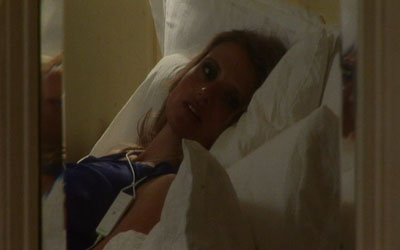
Meanwhile, here is a still from my forthcoming high-definition video artwork entitled Foreign Film (My Autoerotic Muse):
And, as part of an unintentional cinematic (mirror) reflection, here is another still, this one from Bergman's Persona:
In one of his artist's writing, "Cybernated Art," the video artist Nam June Paik wrote:
Cybernated art is very important, but art for cybernated life is more important, and the latter need not be cybernated.
Riffing on this, I would slightly remix his sentiment and write that making contemporary forms of electronic media art involve the creative use of mediating technologies that are situated to augment our experience of life as we look to achieve other states of mind, but are not in and of themselves the literal portals to these other states of mind. Rather, these portals are still part of a deep "interior shot" that feeds off a network of fringe-flow sensations as we experience them via socially interconnected relations.
"Cybernetics," wrote Paik, is "the science of pure relations, or relationship itself" and "has its origin in karma."
Something I learned from Paik, and that heavily informed the creation of Immobilité, was how to use the creative process to put oneself into a trance state that then unconsciously triggers unexpected visions or what in the work I refer to as autohallucinations. In early 2005, I was invited to the European memorial following the death of Paik, and there in Germany I came upon the loose, handwritten notes from an essay he had written around in the early Sixties called "Experimental Television" – that's what he must have called video art in those days – and I was struck by how he too really found it important to write down, to poeticize, what he felt was happening to him as he became this electronically-infused, experimental persona "out of nowhere" – as when he says, referring to the word (in quotes) "ecstasy"
* to go out of oneself...
* completely filled time
* the presence of eternal presence
* unconscious, or super-conscious
* -- some mystic forgets himself (go out of oneself)
* abnormal
* the world stops for three minutes!
This last phrase of Paik's, "the world stops for three minutes!" seems to come out of nowhere too, but also anticipates Carlos Castaneda's "Journey to Ixtlan" where the impersonal "I" of the narrator is being guided through his philosophical life journey by the teachings of Don Juan, the shaman-trickster. Don Juan says to Castaneda's persona:
I am teaching you how to see as opposed to merely looking, and stopping the world is the first step to seeing.
Stopping the world is not a cryptic metaphor that really doesn't mean anything. And its scope and importance as one of the main propositions of my knowledge should not be misjudged.
I am teaching you how to stop the world. Nothing will work, however, if you are very stubborn. Be less stubborn, and you will probably stop the world with any of the techniques I teach you. Everything I will tell you to do is a technique for stopping the world.
The sorcerer's description of the world is perceivable. But our insistence on holding on to our standard version of reality renders us almost deaf and blind to it. I'm going to give you what I call "techniques for stopping the world."
Is this what Paik means by to "go out of oneself..." the way "some mystic forgets himself"? This is my state of mind too while I automatically generate my fictional personas as shareware. Creating my so-called foreign films (so-called in that they are anything but a film of any kind), I realize that forgetting oneself is a necessary aspect of envisioning the work.
The experimental artist Stan Brakhage, who some would say was to experimental film art what Nam June Paik was to video art, often referred to "film as visual music" and spoke about how "the work has to suggest its 'going-on-ness.'"
Which brings up an immediate question: How does a work suggest its 'going-on-ness', especially when you take into account issues of duration, Internet-era attention span, creative momentum, narrative, (re)mixed reality, and interactivity? Immobilité was composed using an unscripted, improvisational method of acting and the mobile phone images are intentionally shot in an amateurish or DIY [do-it-yourself] style similar to the evolving forms of video distributed in social media environments such as YouTube.
By interfacing this low-tech version of video making with more sophisticated forms of European art-house film, the work begins blurring the distinction between the auteur and the amateur, though both may recognize in themselves the desire to become a lover of forms (of formal innovation – as a survival strategy in the co-evolutionary push-pull of the still semi-stable environment).
Brakhage spoke about "a magicwork that makes itself" – a creative force that is filtered through the unconscious and that can only happen once one has freed themselves of the weight of commercial success and other burdens that come with a life fettered with unnecessary attachments. Only then, says Brakhage, can an artist finally blaze the path that they intuitively know they have to make (I'm adding my own associative word-thoughts here now). But before this can happen, you first have to take on the role of prophetic visionary who literally visualize their next creative becoming. How else is the life-art-work continuum to get made?
Sampling from more of Brakhage's phrases that I gleaned from a local TV interview in Boulder, Colorado, we hear him frequently refer to the "buzzing of mind" and "vision of muse" that fills his head like bees in a beehive as the work gets created on its own terms without any interference. He was cautious enough to make clear that not every work will be a magicwork, and any artist who has stuck it out over decades of trial and error via an intense, post-studio, art-research practice knows this to be the case. Sometimes it just comes out, sometimes not. And when the creative momentum one experiences while making a specific work is lost, you are never really sure if you will get it back. These are the risks one takes when developing their new material in a variety of media/mediums, especially when it's time-based new media that they are porting their poetic vibes through.
The unconscious experience of the intuitive body becoming new media...
Think of it as creating an active unconscious momentum, where the proprioceptive artist-medium "knows" where they are going without ever having been there before.
Or: imagine the artist-medium playing out their aesthetic potential via an innate body intuition, flushed with the illogic of sense (data), operating on autopilot.
The history of new media is the history of the world. For example, we can time-travel back to Germany in 1805, where we find a short essay written by Heinrich von Kleist, collected in his now out of print An Abyss Deep Enough. The essay is entitled "On the Gradual Fabrication of Thoughts While Speaking," where the author intuits the unconscious neural mechanism that triggers creative thought and writes:
For it is not we who know; it is rather a certain condition, in which we happen to be, that 'knows.'