Friday, June 07, 2013

Mark Amerika's Video Art at Denver International Airport

A series of four of my short video artworks are now on exhibit at the Denver International Airport. Where exactly in the airport are the videos playing? Well, you can't miss them. They are located on the two large cylindrical towers in the center of the airport's main building. The moving images are playing on the two huge wrap-around screens provided by Clear Channel Airports in collaboration with the airport and the artist.


The artworks featured in this series are made especially for the airport's art and culture program. Titles include "Glitch TV," "Data Falls," "New Aesthetic TV" and "Second Nature." In discussing these new artworks featured in the airport, I was quoted as saying that "[t]hese works grow out of my recent exploration into the relationship between data flow and the flow of life. Sometimes life can be perceived as a rather normative experience but one that is boring and predictable, while at other times our daily perceptions can be glitched or altered by the digital devices we depend on for our communication and information gathering. For example, what if the delivery of high definition data streams start breaking up and creating colorful artifacts you have no control over? One response would be to become impatient with the technology as it dysfunctions right before our eyes. In fact, these disturbances can be visualized as little or even big glitches that at first may seem a nuisance but, on second look, from an artistic perspective, are actually more interesting than the clear signals we're used to seeing in commercial culture. This is what I explore in my ongoing investigation into glitch aesthetics."

A short video of the exhibition can be found here.

These shorter videos grow out of my recent investigation into glitch aesthetics as featured in my last major work of net art, Museum of Glitch Aesthetics (2012), a major art commission sponsored by Abandon Normal Devices and the Harris Museum in conjunction with the London 2012 Olympics. The artist wishes to thank Matt Chasansky, the Denver International Airport Art and Culture Program and Clear Channel Airports for sponsoring this exhibition.


Keywords: Mark Amerika, glitch, aesthetics, public art, video art, Denver International Airport

Monday, June 03, 2013

From "The Circulation Desk"

Excerpts from The Circulation Desk, a forever-work-in-progress:

"We're not into making things mean something so that some cultural analyst can interpret our work for us. That's too narrowly focused."

"We would rather just let our work live, out there, say, on the Net, and let it circulate freely, a kind of becoming-transmission."

"It's more about how the movement of aesthetic forms creates a mobile net aesthetic which produces a vibrant social texture to get lost in."

"The idea of circulation, of intervening in the transmission process, is related to the field of distribution as an aesthetic form."

"It's not about - 'if we build it, they will interpret us' [and then we will monetize it] - it has more to with us moving in social space."

"We're playing with the archive in an ahistorical or transhistorical style, not academic or even theoretical per se, but as speculative samplers falling in and out of undulating ensembles of remixologists performing in auto-affect mode."

"It's strange - we track the co-poietic unfolding of network distributed aesthetics as a kind of embodied praxis. The idea is to resist the defeatist retreat back into the ready-to-be-psychoanalyzed 'self' per se while seeding new forms and tempos of living itself."

"We study ephemeral forms the way a painter might draw or do a quick napkin study that then leads to a large-scale painting or sculptural object. For instance, we'll challenge ourselves to embody a rhythm in a fast-moving game environment just to see what it feels like to create and satisfy needs based off that team's particular game design aesthetic, and then we'll take that rhythm and try to superimpose it on something completely distinct from it, like reading a dense theory book during our 'free time.'"

"When we scroll through a city and make unconscious links with the terrain as if becoming 21st century psychogeographers, we'll simultaneously begin re-mapping our aesthetic trajectories -- so that circulating in a neighborhood becomes our version of a performance art project focused on duration and the ability to intersubjectively relate with the denizens of the micro-culture we're immersing ourselves in. You could say that our art cannot be located in the objects that we construct and that contain our potential legacy if only historians and critics and curators and collectors could unlock the secret meaning stored within . . . in fact, our art is really more like Duchamp's register of the 'anartist' -- the not-artist -- and yet there's still no getting away from aesthetics, from the desire to assemble systems of circulation and internetworked communication and distribution that layer our experience with something well beyond meaning. It's much more textural and could be better described by words like 'disgusting,' 'stimulating,' or "optimum flavor profile.'"

"Another way of putting this would be, 'Experiencing the ecstasy of transmission is an intuitive process that, when informed by the edges of an applied aesthetics, can turn into realtime reality hacking."


Keywords: circulation, style, net art, transmission, psychogeography, aesthetic forms, against interpretation


Friday, March 08, 2013

Transgressive Shareability

Last year, my essay-dialogue with new media theorist and philosopher David Gunkel covered a wide range of issues including remixology, remixthebook, glitch aesthetics, transgression, and even university art school politics. The dialogue was published as a chapter in Transgression 2.0: Media, Culture, and the Politics of the Digital Age (Routledge). Here is an excerpt:

In my book META/DATA, I see this co-emergence and the co-response-ability that comes with it as a way to affectively become what I call the not-me. The not-me rejects a self-situated ethics of being and instead remixes digital flux personae into a transgressive form of networked performance that experiments with subjectivity in the field of distribution. It's like what Paul Miller (aka DJ Spooky) writes in Rhythm Science (2004) when he refers to "persona as shareware" and Ettinger refers to as "transgressive shareability" (Ettinger 2006, 168) Daily remix practice is not a self-centered ritual of dissipating the ego. It's much more intense than that. I think of it as a kind of embodied praxis where the artist-medium builds their chops by conducting an open source, cut-and-paste as-you-go, digital lifestyle practice that operates as part of this larger, com-passionate agenda to nurture feelings back into the mix. This is the only we can even approach what Whitehead refers to as the Higher Phases of Experience.

The entire chapter can be downloaded here.


Keywords: remixology, glitch aesthetics, transgression, Mark Amerika, David Gunkel, Bracha Ettinger, DJ Spooky, Routledge

Tuesday, March 05, 2013

Micro-Cinematic Essays... On Exhibit @calit2 in San Diego

On January 17, 2013, Micro-Cinematic Essays on the Life and Work of Marcel Duchamp dba Conceptual Parts, Ink opened as part of the Three Junctures of Remix exhibition at the @calit2 gallery at UCSD in San Diego. The exhibition runs through March 15, 2013 and is curated by Eduardo Navas.

According to Navas, "The exhibition THREE JUNCTURES OF REMIX features the art of Mark Amerika & Chad Mossholder, Arcángel Constantini, Giselle Beiguelman, and Elisa Kreisinger, a group of international artists who have explored and reflected on the implications of the creative act of remixing since the concept became popular beginning in the nineties. The art works crossover and explore three junctures (moments of production) of remix: the pre-digital/analog; the digital; and the post-digital which developed in chronological order, but after their initial manifestation, became intertwined and currently are often reintroduced in conjunction to inform the aesthetics of remix as a creative act in art practice. The exhibition is curated to reflect on how computing has enabled people to recombine pre-existing material with unprecedented efficiency that is relatively affordable just about everywhere information-based technology is widely used. This has affected how local and global communities view their cultural production, from politics to the arts."

Micro-Cinematic Essays on the Life and Work of Marcel Duchamp dba Conceptual Parts, Ink is a collaborative "conceptual art" album featuring my own writing and vocals (much of it recorded using my iPhone Voice Memo app) and the sound design of electronic music composer Chad Mossholder. The work consists of nineteen experimental tracks that we refer to as "close readings" focusing on the work, language, and notes of Marcel Duchamp as well as his influence on contemporary forms of remix practice. Many of the tracks actually remix my own voice with the voice of Duchamp. An exploration into glitch, microtonality, and the spectral analysis of recorded voices over time, Chad and I surgically alter the aesthetic frequency of what is often referred to as "the artist's voice" and, in the process, invite the listener to rethink the interrelationship between critical writing and critical listening.

The work is now available in limited edition either through our Bandcamp site or by contacting the artists directly.

Keywords: calit2, SDSU, Three Junctures of Remix, Mark Amerika, Marcel Duchamp, Chad Mossholder, remix, Symbolic Sound, kyma

Thursday, January 10, 2013

To Quote

"I force myself to contradict myself so as to avoid conforming to my own taste."

"The value was in the way you branded the context ... How’s that for relational aesthetics?"

"True, the successfully sequestered commercialization of a few artists can be maintained in a tightly managed high end art market, but this says nothing about the anartist who transubstantiates the networked scene they are part of."

"It comes down to this: the auto-affection of the thing that has no center vs. the ontological unit that imagines itself to exist in bodily form while procuring its evolving style of moving-remixing."

"My teaching style? I'll play it for you first and tell you what it is later."

"An indeterminate and unconscious 'redo' so smooth and seamless that the initial action apparently never really happened in the first place, even though others may swear it did."

"To reach the impossibility of transferring from one like object to another the memory imprint."

"Was Wittgenstein a closet lesbian?"

Keywords: memory, remix, transubstantiate, anartist

Tuesday, January 01, 2013

Affirmation

For the last seven years, I have selected one word on January 1st to trigger creative developments throughout the new year.

In 2006, the word was improvisation.

In 2007, the word was intuition.

In 2008, the word was illumination.

For 2009, I was feeling the heat and knew I had to go with intensification.

Looking into my miniscule crystal ball for 2010, I anticipated things remaining as intense as ever but also sensed a noticeable pattern shift occurring in the world all around me, one that I knew was having an effect on all of my new project development, a shift that would ideally enable me to transmute the intensity of daily remix practice into multiple and hybridized forms of actualization. Three years ago, trying to side-step the new age connotations of the term actualization while addressing why it stood out to me as a word indicative of a shift in my perspective [further signaled by the fact that my new words of the year would now begin with the letter 'a' instead of 'i'], I wrote down some thoughts which I am remixing below:
By creating more flexible life patterns we may be able to renew our energy (source material) in ways that trigger yet more intense experiences not just for ourselves but for others. Doing this at the level of daily remix practice as part of an intentional strategy to take the creative process deep into ones shape-shifting underground network via a process of mediumistic actualization feels like just the right thing to do.

As Whitehead wrote in Process and Reality, the primordial nature "combines the actuality of what is temporal with the timelessness of what is potential."

How do we network this potential so that it feeds into more intersubjective, remixological practice?

What does it take to access the source of creativity?

In digital terms, is it as simple as maintaining a net connection while proactively engaging with ones distributed social network?

How does one become an artist-medium that positions their daily practice in relation to the greater creative potential of what lies ahead while acting as an accomplice to an ingression performed by timeless entities whose concrescent formation manifests itself as an actual achievement in time?

Is actualization always already just-in-time?

Or is it always on the cusp of "becoming" -- the idealized condition of "being avant-garde"?
Actualization was a term that challenged me three years ago and two years ago "the secret woid" (Groucho Marx) was agglutination. On January 1, 2011, I wrote how my emerging art projects were
... driven by an adherence to my daily remix practice. The bottom line is that I need to maintain my practice as intuitive stick-to-itive-ness. Maybe the word I am looking for is sticktuitive. Setting my mind on autopilot, my aim is to continually remix the patterns into new forms of mosaic. But the mosaic, as fluid as it may be, needs to hold together in order for me to feel the need to proceed. It has to agglutinate.
Therefore, I wrote, "the trigger word for 2011 is agglutination. Even if some elements lose their 'stickiness,' dislodge, and drift away, I will be paying attention to those things that adhere to each other and create greater clusters of potential to actualize."

Last year's trigger word was even more difficult for me to write about than actualization. The religious connotations of the word I wanted to use were more severe than some of the new age connotations of prior words. I was thinking of what Whitehead refers to as the "Higher Phases of Experience" and, in some instances, quite literally the concept of soaring. A simple thesaurus check on synonyms quickly revealed one 'a' word for "soaring" and that was ascend. But ascend was too descriptive and lacked the intensity of what I was really feeling a year ago. So the word-trigger for 2012 was a stretch, even for me. That word was ascension.

Yes, there was something about the mystical act of ascending to another world before dying that appealed to me, but I was mostly interested in something that had very little or nothing to do with the more organized, religious uses of the term. For me, the idea of ascending was more about climbing, flying, soaring. What does it mean to "rise above it all"? To "take it all to another level"? And then I had some side thoughts that I remixed from my last book, remixthebook: is it possible to rise above it all while staying grounded? What's the relationship between ground and instrument? Instrument and medium?

It was relatively easy for me to come up with my trigger-word for 2013. My "long talking bad conditions blues" (to borrow a phrase from the title of Ron Sukenick's novel of the same name) has been going through a radical metamorphosis over the last decade. I am just as likely to spend valuable time improvising the occasional bon mot for my Twitter stream as I am creating a huge and complex work of art like Museum of Glitch Aesthetics (for more info on MOGA and many other developments up through October 2012, go to my linkfest).

But it was the so-called micro-blogging that I turned to time and time again, not to share my every act or thought with my limited number of followers (though that happened too), but to maintain my thought-flow and let it ride the social media network as if it counted as a kind of micro-publication performance that could then feed into more elaborate work development. In fact, some of my tweets have prodded me into short stories that have begged to become novels or anti-novels entering the digital unknown:
RT @remixthebook Is this consensual hallucination really a collaborative fiction generated by an actant-network parallel processing concrescent prehensions?
What was I really asking there? Was that a cleverly manipulated remix of every metafiction novel I have ever read and wished I had written?

Or what about this one:
The core artist-professor remix act mashes up ones immersion in The Festival with an on-the-fly management style that hacks the academy.
Only a 21st century Derridean remixologist who doubles as a practice-based researcher teaching / working with talented graduate students who are busily reinventing what it means to be an artist in network culture could have tweeted that and known exactly what he meant.

Or this tweet:
Each life is encyclopedic, an archive, an inventory of objects, a satchel of styles, and everything can be remixed in every conceivable way.
And this one too:
Becoming the clinamen, Our Lady of Remixological Tendencies is simply the unimpeded part of a flow which ensures such a flow has no fate.
And:
What does it mean to lose ones own voice in a glitch-remix performance that metamediumystically embodies the voice of another artist-medium?
Seriously, there are ten books dying to grow out of those last three tweets.

Even if these short thought-takes amount to extraneous filler that will never amount to anything more than what they are, i.e. short tweets delivered via a social media networking service and micro-blogging site, that's more than enough for me. When you have successfully bypassed the need to use your creative work as an excuse to experience something like catharsis and have opened yourself up to the flow of trans-subjective performance/writing, anything is possible. Daily (remix) practice is more about achieving higher states of affirmation than, say, adhering to a set work protocol that routinizes the way one monetizes their labor.

2013 is the last of A words. This year's word-trigger is affirmation. Affirmation is tricky because it suggests that one has, in fact, found the truth. But for me, and this is really funny but typical for my own thinking, affirmation reminds me of Affirmed. Do you remember Affirmed? The last horse to win the Triple Crown.

Why do I think of Affirmed in relation to affirmation, besides the obvious root word significance? Because Affirmed had to fight hard to win every one of the three races. There was never any chance for the horse to pull back and take it easy. It was never in the bag. It was generally assumed that every race Affirmed entered would be a challenge like never before, and the horse would have to leave everything on the track.

Can I relate?

That would be affirmative.

Hau'oli Makahiki Hou.

Keywords: intuition, improvisation, illumination, intensification, actualization, agglutination, ascension, affirmation

Friday, December 28, 2012

Remixology (A Theoretical Fiction)

The new issue of Media-N: Journal of the New Media Caucus is out. The theme for Fall 2012 is Found, Sampled, Stolen: Strategies of Appropriation in New Media and features writings from a diverse group of artists and theorists including Cornelia Sollfrank, Eduardo Navas, Steve Gibson, Sarah Cook, Marialaura Ghidini, Grant Taylor, and myself.

In guest editor Josh Rosenstock's introduction, he writes:
Although the term “appropriation art” came into widespread use during the 1980s to describe the work of a particular group of artists, appropriation-based concepts and practices are at the core of many of the key moments in modern and postmodern art history. Media artists today emulate appropriative movements from across the past century, from Dadaist readymades, to Pop Art’s ironic reuse of mass media detritus, to Hip-hop’s sampling and DJ remixing. Indeed, appropriation strategies and remix thoroughly permeate contemporary artistic practices of creation, archiving, and dissemination. Although appropriation is now a familiar part of contemporary art, recent evolution in the legal, conceptual, and technological landscapes of media art have brought to the fore newer discourses concerning copyright, sharing, memes, data, and the ever-increasing penetration of networked computing into all aspects of daily life. This issue of Media-N brings together a fine assortment of artists, art historians, curators, and theorists to present a lively chorus of viewpoints on the state of appropriation in new media art.
My own contribution, Remixology (A Theoretical Fiction), is what I would refer to as a "remixological fiction" that doubles as a rhetorical drift into new modes of theory-production. Similar to my approach in remixthebook (University of Minnesota, 2011), narrativize my own pedagogical practice as a professor of art and art history, although this time, instead of filtering the writing through a poetic measure influenced by the likes of David Antin, Allen Ginsberg and Robert Creeley, the work is clearly influenced by William Gaddis' J.R. which I was finally finishing at the time I was writing the remix-essay. Here's an excerpt:
...an assemblage of remixologists-in-training, para-professional adjuncts, #NewAesthetic pataphysicians, digital bricoleurs, Net art nomads, DIY zinesters, and psychogeographers are congregating at the local café where the barista on-duty is known for her raucous late night behavior that she is totally entitled to get away with because according to those in the know i.e. the 2012 International Barista Competition judges who presided over the event in Portland, Oregon, what she does with a cup of freshly roasted Montes de Oro Costa Rican bean roasted by the pros over at Coava Coffee Roasters is the total shit

–Are you taking his remix course too?

–Yeah, we all are. We have to.

–Have to? You mean it’s re –

–required, yeah, or not really required.

–She’s right. It’s not required, it’s just that we have to have one theory course as part of our curriculum before they’ll give us the MFA and it’s between his remix course and one of those other ones that focus on –

–Heidegger.

–Yeah, Heidegger.

–Hail, Heidegger!

–Heidegger, Schmeidegger. What I like about his remix course is how he gets us to a) read all of that art theory written by the artists themselves and then, b) he also makes us read this intense experimental literature written by people like Kathy Acker and Tan Lin and who else?

–Well, there’s that Jonathan Lethem essay, The Ecstasy –

The Ecstasy of Influence.

–Yeah, exactly. I think it’s a play on old school English lit studies, something about the Anxiety of Influence.

–Yeah, well, my only anxiety is how I’m going to pay the rent after I graduate. Besides that, I’m happy to be influenced by just about anyone as long as it’s not myself.

Keywords: Remix, remixology, remixthebook, Mark Amerika, Media-N, New Media Caucus, Found, Sampled, Stolen: Strategies of Appropriation in New Media

Tuesday, November 27, 2012

Anartist

As much as I have been using the term anti-disciplinary to mash-up the twin conceits of anti-authoritarianism and interdisciplinary methods of practice-based research into emerging forms of digital creativity, I must say that I have always had difficulties with all of these terms. Basically, I am interested in pursuing what in remixthebook I refer to as "a cut-and-paste as-you-go open source lifestyle practice" -- which to me is different than what I think of as a contemporary art practice. Sure, the work I (post)produce eventually manifests itself in various art forms, defamiliarized genre spaces, and multi-platform distribution schemes, but that's not why I make it. I make it because I have no choice in the matter. It's a mode of survival. In fact, you could say that it -- the making -- makes me.

But makes me what? An artist? OK, I can live with that (but then again, I can live with a lot of things). As I continue my deep research investigation into Duchamp and particularly his Large Glass, I am reminded of the term he once used to describe his own role in the cultural milieu he happened to be circulating in.

Duchamp:
For me there is something else in addition to yes, no or indifferent - that is, for instance - the absence of investigations of that type. . . . I am against the word 'anti' because it's a bit like atheist, as compared to believer. And the atheist is just as much of a religious man as the believer is, and an anti-artist is just as much of an artist as the other artist. Anartist would be much better, if I could change it, instead of anti-artist. Anartist, meaning no artist at all. That would be my conception. I don't mind being an anartist . . . What I have in mind is that art may be bad, good or indifferent, but, whatever adjective is used, we must call it art, and bad art is still art in the same way as a bad emotion is still an emotion.
Duchamp was incredibly clever at giving voice to thoughts that resonate well into the first decades of the 21st century.

Speaking of Duchamp's voice, my new art work, Micro-Cinematic Essays on the Life and Work of Marcel Duchamp dba Conceptual Parts, Ink, is now available in a limited edition of eight. The work was made in collaboration with sound artist Chad Mossholder. Talk about remixologically inhabiting the artist as medium. At certain points in the composition, there can be no doubt that my own voice loses itself the glitch of remix performance and embodies the sound of the anartist.

Keywords: Marcel Duchamp, anartist, medium, remix, glitch, experimental audio, sound art

Tuesday, November 20, 2012

Video in the House of the Word (The Huffington Post Interview with Mark Amerika)

From Video in the House of the Word: How e-Lit Intersects With Cinema, the just published interview with me on The Huffington Post conducted by artist and writer Illya Szilak:
For writers of electronic literature, the relationship between text and image remains just as fluid as it was for their forebears, the experimental filmmakers.

In the extreme, filmmakers like Stan Brakhage utterly reject text, imagining a world before "in the beginning was the word," an ecstatic visual experience beyond language. Others, like Frampton, suggest that text is useful for exactly that purpose that famed Soviet director, Sergei Eisenstein decried it, for necessitating "fanciful montage structures, arousing (the) fearsome eventuality of meaningless and reactionary decadence." In other words, by reinserting text into film and manipulating the interplay of language, sound and image, the "natural" unity of images and language, familiar to audiences since the "talkie," can be undercut, and the mechanism of cinematic seduction and mesmerization revealed.

It is this subversive potential of text in film which Mark Amerika, one of the pioneers of electronic writing, utilizes in his work. In 2000, his Internet site GRAMMATRON, which combines grainy moving image with text, hypertext and ambient soundtrack, was included in the Whitney Biennial.
After reading the interview, you would be well advised to check out Szilak's new work of transmedia narrative, Queerskins.

Keywords: Cinema, electronic literature, e-lit, Mark Amerika, Stan Brakhage, Hollis Frampton, hypertext, ambient, electronic writing

Sunday, November 11, 2012

Out Here (by Mark Amerika)

Out Here (by Mark Amerika)
-- In Memoriam to Patrick Simons


Out here there are a lot of fun things to do.

It's like there's so much to do that I forget that I am supposed to be a writer.

I used to worry a lot about my "not writing."

But now I am walking a lot of the time and have forgotten what it means to worry about anything.

A lot of my time is being walked away.

My walking is leading me to a space beyond time per se and this has enabled me to develop a deep, topographical / thoughtographical practice that constantly remixes the ongoing interrelationship between my body's heightened state of spatiality as movement-feeling-remixing and the simple idea of tracing lines of thought that get ported through the networked field of distribution.

My walks document this moving-feeling-remixing practice by leaving feint imprints on the neuromuscular memory streams coursing through my days (and night drifting).

These moving-feeling-remixing neuromuscular memories that stream through my body are like flickering imprints of realtime publications that are impossible to read and conveniently disappear before I have a chance to consciously process them.

But then again, who needs to read a memory when you can literally create one as an experiential movement distributing itself through the dreamtime network?

So, instead of reading memories, I (continually) (over)write the.

The what?

Corpuscular code treading my bloodline.

Every now and then, these perambulations that I unconsciously archive in my neuromuscular movements as part of an ongoing spatial practice are transcoded into other, more orderly, and even ordinary languages that are then manipulated in various digital editing environments.

These digitally edited remixes are basically meta-versions of what it feels like to write-while-walking.

Writing-while-walking is how I compose myself for the Mobile Media Apparatus that distributes my various networked personae in asynchronous realtime.

It's just that nobody really knows that, unless we go on a long walk together.

In this regard, I have become a networked and mobile medium seeking his way out to a clearing.

Some have even suggested that this is what makes me a truly "contemporary" artist.

But I resist these labels as much as possible even as I can't help but continually label and re-label myself as a kind of auto-branding mechanism who becomes what he is simply by doing what he does whenever he does it.

Right now, I'm fully loaded with easygoing love apps that are sensitive to the touch and the more I launch them the more I become less "me" per se and more "them" (thems The Ones, the ones that touch me back).

Every now and then I'll launch a particularly robust love app and it will feel just like.

Just like what?

Corpuscular code treading my bloodline.

But most of the time it doesn't.

Though even when it doesn't, it still feels w-r-i-t-e.

That is to say, it still feels like a live, postproduction set (a processual enterprise of mystorical intent).

Nowadays, I welcome the challenge of not being myself even as I mobilize my body into the next spatial consequence forming itself right in front of me (and this is how she gets me every time, and every time I'm stunned that it can still go down that way).

How to put it in as succinct a manner as possible?

"This is how I roll/play."

Or: this is moving-feeling-remixing as embodied praxis.


Keywords: mobile medium, contemporary artist, Mark Amerika, walking, writing, asynchronous, realtime

Friday, October 26, 2012

Torn Theories Ripped from my iPhone Storage Unit

Digital notes, torn from memory and replicated as a theoretical data set:

Is this still writing? Am I right to still go on trying?

Working the archive in an ahistorical or transhistorical style, not academic or even theoretical per se, but as a speculative sampler.

Remixology is life as embodied praxis. It resists the defeatist retreat back into the "self" & seeds new forms and tempos of living itself.

Remixology as embodied praxis is about forming one's rhythm in a game that seeks to create and satisfy needs, to play with/in "free time."

Remixologically (per)forming one's embodied practice as an artist-medium experiencing the ecstasy of transmission, is an intuitive process.

Mashing up Duchamp's idea of the artist as medium with Nam June Paik's vision of the artist as mystic = artist-as-mediumystic player.

The metamediumystic remixologist who intuitively performs the ongoing becomingness of postproduction, embodies aesthetic form as difference.

Remixological value is felt as a particular quantity of qualities undergoing a process of postproduction: a "concrescence of prehensions."

Remixology invents a morphing form of "digital ecology" by spinning value propositions out of the unconscious potential of data's substance.

Inventiveness is born from remixing everyday life, not through the action of individual genius, but the mashup of collective play.

Remixology is social media performance art as embodied praxis.

But can this practice-based research in social media performance art be taught?

Can it be modeled within the confines of a conventional, scholarly practice - or even a conventional, academic art school context?

Universities pay lip service to the idea of "creative work" but rarely invest in its expansive potential to change the research environment.

Is that because once you let that bad ass cat out of the bag then all bets are off & the apparatus becomes subject to reality hacking?

The core of an engaged remixologist's radical praxis can be found in how they produce and creatively make use of free time.

Creating free time = "playing in festivals" = performing the radical remixologist's ludic lifestyle practice as an open ("creative") work.

But when will THAT get you tenure -- get you tenure OUTSIDE an academic context?

This ludic, cut and paste as-you-go, open source lifetsyle practice that fuels remixology's effects on the digital ecology, is innate.

The operative word is "co-operative" ...

Remixological bioformalism and evolutionarily stable emergAgency nurture the transgressive share/ability of the Source Material Everywhere.

It's a Co-Poietic World After All.


Keywords: remix, remixology, open source, life, source material everywhere, Mark Amerika, remixthebook, practice-based research

Tuesday, October 16, 2012

2012 Link Fest: Everything, All At Once

A lot has happened over the last few months and there is still quite a bit more to come before the year is out. Here are some highlights with associated links:

Museum of Glitch Aesthetics: My new commission with Abandon Normal Devices (AND), my new artwork, Museum of Glitch Aesthetics (MOGA) launched online in late June and is available for interaction at glitchmuseum.com. MOGA is the latest work in my collaborative series of transmedia narratives (see Immobilité for another recent example of this new form of contemporary art). MOGA tells the story of The Artist 2.0, an online persona whose personal mythology and body of digital artworks are rapidly being canonized into the annals of art history. The piece traces the life of the artist and his ongoing commitment to a practice of “glitch aesthetics” that leads to the museum name in the title. MOGA features a wide array of artworks intentionally corrupted by technological processes including net art, digital video art, digitally manipulated still images, stand-up comedy, sound art, and electronic literature. The project also includes a full color museum catalog available in both free e-book and limited edition print editions. (For those who never caught the video trailer for MOGA, you'll definitely want to experience it here).

AND Festival: A few months after the online launch of MOGA as part of the Abandon Normal Devices festival, a physical installation of the work was curated by Omar Kholeif and appeared at the Lionel Dobie gallery in Manchester, UK. My long time collaborator Chad Mossholder made the trip out the UK with me for the opening and, while in Manchester, we also performed with the powerhouse poet and rocker Lydia Lunch and the Japanese noise band Bo Ningen. The night of performances took place at The Sally (The Salutation Hotel) and was titled Machines By Other Means. Two words about that whole trip: total awesomeness.

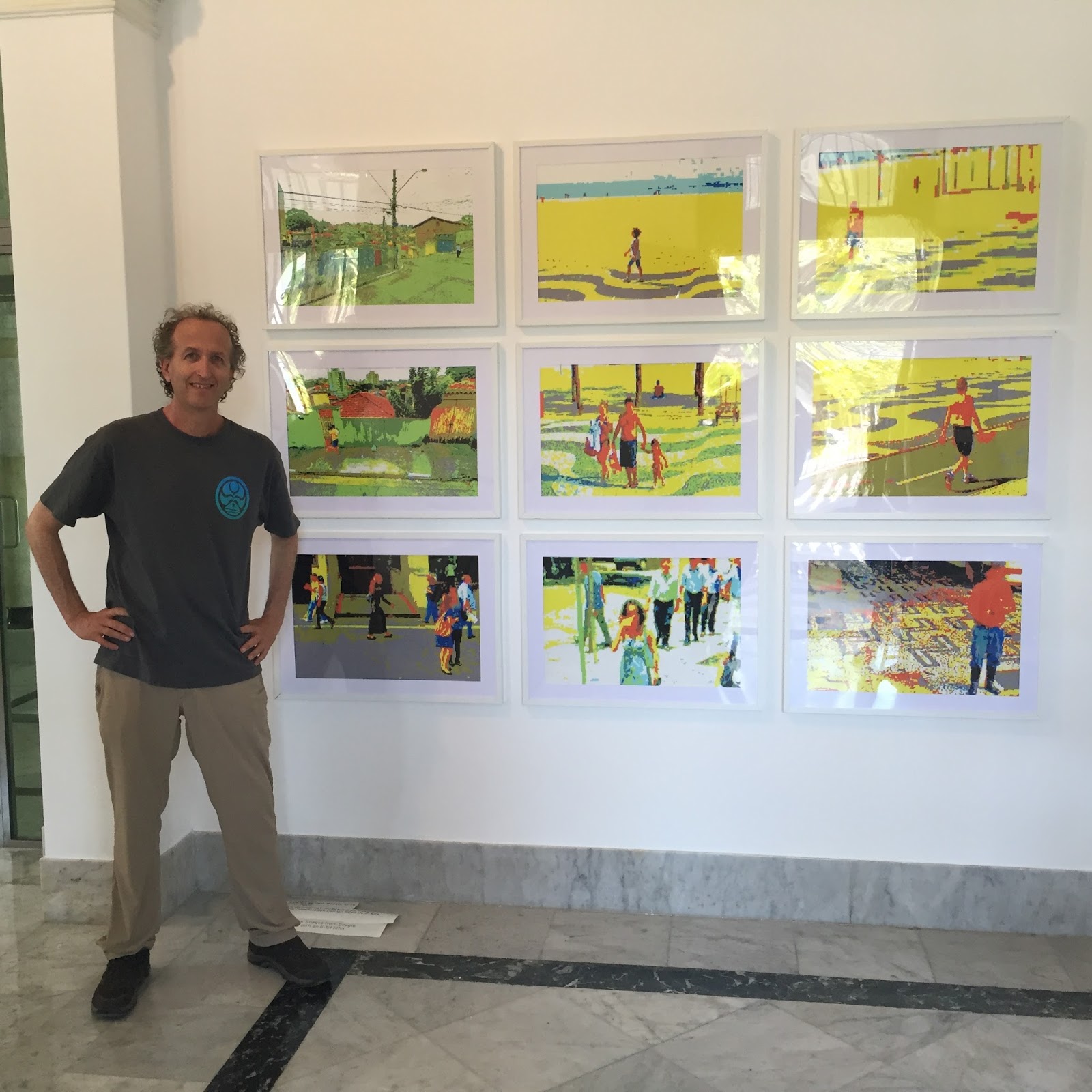
Digital Aesthetic 3: DA3 is large-scale exhibition and conference in the Northwest of England that takes place at the Harris Museum and the PR1 Gallery in Preston. As one of the co-commissioners of MOGA along with Abandon Normal Devices, the Harris Museum exhibition includes a very different physical exhibition of MOGA. Whereas with the exhibition at Lionel Dobie in Manchester, MOGA helped launch a new art gallery focused on experimenting with contemporary curatorial practice in digital times, the exhibition curated at the Harris Museum is puts a different narrative spin on The Artist 2.0. Given the historical range of works already on permanent display in the museum, the curatorial team led by Lindsay Taylor came up with a brilliant idea to "glitch the museum," i.e. to distribute some of the digital images (as thumbnail prints), audio tracks, animated GIFs, and videos throughout the museum so that the work would immediately engage in a dialogue with museological practice. Mano y mano, museum y museum. Here are some images of the exhibition:

Postscript: Writing After Conceptual Art: On October 12, 2012, my new sound art work, Micro-Cinematic Essays on the Life and Work of Marcel Duchamp dba Conceptual Parts, Ink, created in collaboration my long-time colleague Chad Mossholder, opened as part of the Postscript: Writing After Conceptual Art exhibition at the Museum of Contemporary Art Denver. The exhibition runs through February 3, 2013. The show will travel to the Power Plant Contemporary Art Gallery in Toronto in June 2013. The exhibition is co-curated by Nora Burnett Abrams and Andrea Andersson and includes work by Carl Andre, Erica Baum, Derek Beaulieu, Caroline Bergvall, Jen Bervin, Jimbo Blachly & Lytle Shaw, Christian Bök, Marcel Broodthaers, Pavel Buchler, Luis Camnitzer, Ricardo Cuevas, Tim Davis & Robert Fitterman, Monica de la Torre, Craig Dworkin, Tim Etchells, Ryan Gander, Michelle Gay, Kenneth Goldsmith, Dan Graham, Alexandra Grant, James Hoff, Seth Kim-Cohen, Sol LeWitt, Glenn Ligon, Tan Lin, Gareth Long, Michael Maranda, Helen Mirra, Jonathan Monk, Simon Morris, João Onofre, Michalis Pichler, Paolo Piscitelli, Vanessa Place, Kristina Lee Podesva, Seth Price, Kay Rosen, Joe Scanlan, Dexter Sinister, Frances Stark, Joel Swanson, Nick Thurston, Triple Canopy, Andy Warhol, Darren Wershler, and Eric Zboya.

Moscow International Film Festival and MediaLab: The third part of my net art trilogy, FILMTEXT 2.0, was on exhibit as part of the 2012 Media Forum exhibition, “The Immersion: Towards Haptic Cinema,” in conjunction with the 2012 Moscow International Film Festival. The exhibition took place at The Ekaterina Cultural Foundation from June 22 — August 19, 2012 and was curated by art historian, curator, and director of the MediaLab in Moscow, Olga Shishko. It was great honor to exhibit my work with other historical figures such as Dziga Vertov, Sergei Eisenstein, Nam June Paik, Peter Greenaway, Kazimir Malevich, Ken Jacobs, Hans Richter, Pia Tikka, Valie Export, Luis Bunuel, Stein and Woody Vasulkas, and many others.

MIX: Merging Media Conference: MIX took place at Bath Spa University’s postgraduate centre at Corsham Court from 16th-18th July 2012. Its aim was "to bring together practitioners and theorists working with writing in digital media." The purpose of the event was to create a core group of practice-based researchers who both play-to-play and create their own theoretical frameworks to operate in. My opening keynote address was on transmedia narrative and remixology (a transcript from earlier versions of this keynote delivered in Rio de Janeiro and Melbourne can be found here).

"Comedy of Errors" exhibition at Pratt Univerity: This excerpt from Museum of Glitch Aesthetics was on exhibit at Pratt in conjunction with my visiting artist presentation in September. "Comedy of Errors" can be experienced at the MOGA website.

Ctrl-Z: My theoretical fiction and accompanying soundtrack "Seminar" appeared in the premiere issue of Ctrl-Z, a journal focused on the philosophy of new media. These excerpts are from a larger transmedia project I am just now developing and that has TWO working titles one which I am leaning toward at the moment: Inside the Green Box (can you guess where I get that title from?).

Vague Terrain: This special issue on Mobile Performance includes an interview with me conducted by guest-editor Camille Baker.

remixthebook reviews: More reviews came out on my last book, remixthebook, including the Times Literary Supplement (link unavailable). This surprising review (quite positive) came out in The Melios, a religious journal. Other reviews have appeared in Art Monthly, furtherfield, and Leonardo. remixthebook also came up in Simon Reynolds polemical essay in a recent issue of Slate.

Streaming Museum: Streaming Museum's "Artistic License"@ ZERO1 Biennial in San Jose was launched on September 14. My contribution to the exhibition is a remix of the video art trailer for MOGA, a work I titled #NewAesthetic Video. The Biennial runs through December 8.

Upcoming gigs include performances and presentations next month at ELMCIP in Edinburgh, MOGA at the Harris Museum, and a guest lecture at the Winchester Centre for Global Futures in Art Design & Media at the University of Southampton right near London (lately it feels like the UK is my third home after Boulder and Kailua).

Keywords: Mark Amerika, Museum of Glitch Aesthetics, mobile media, remixthebook, Marcel Duchamp, Postscript, Digital Aesthetics 3

Tuesday, October 09, 2012

Images from Museum of Glitch Aesthetics Installation

Museum of Glitch Aesthetics (MOGA) is now on exhibit at the Harris Museum and Gallery in Preston, UK, as part of Digital Aesthetic 3. DA3 is "an international exhibition and conference which explores the impact that the digital has on our sense of self and our relationship to the physical world."

As part of the ongoing and openly remixed installation of Museum of Glitch Aesthetics, a selection of digital prints, animated gifs, streaming audio, mobile gadgets, and web outputs have been distributed throughout the Harris Museum and some pictures of the installation have just been posted online here.

I'll be speaking at the Harris Museum on November 6th.

Keywords: Museum of Glitch Aesthetics, Harris Museum, Digital Aesthetic 3, Mark Amerika


Sunday, September 02, 2012

Update: The Unofficial Catalog for the Museum of Glitch Aesthetics

The opening section to the Museum of Glitch Aesthetics catalog is written in a Wikipedia-like style and is not attributed to any particular author. The catalog opens:
This article has multiple issues. Please help improve it or discuss these issues on the talk page.
  • * This biography of a living fiction role-playing itself as a digital flux persona needs additional citations for verification.

  • * It needs attention from an expert on the subject.

  • * Its mythological use of narrative techniques camouflaged as art history may not follow standard policies or guidelines.
The entry-as-narrative then begins:
The Museum of Glitch Aesthetics features the life and work of The Artist 2.0. The Artist 2.0 is the eponymous figure whose early 21st century oeuvre is featured online in the Museum of Glitch Aesthetics (MOGA). Presented as an "open persona" whose practice is a composite of hundreds of artists and hactivists all over the world, the story of The Artist 2.0 is playfully documented via the experimental transmedia narrative created by the artist Mark Amerika as a new commission for the Abandon Normal Devices festival in the Northwest of England and in conjunction with the London 2012 Olympics and Cultural Olympiad. For reasons that remain unknown, "The Artist 2.0" persona was created to indicate how an emerging form of art making associated with social media practices and an emerging New Aesthetic are simultaneously challenging conventional art world exhibition contexts as well as embedding themselves in the art historical canon. In this regard, The Artist 2.0 is perhaps the first fictional figure whose body of work grows out of the emerging networked and mobile media culture and whose career trajectory is now part of a continuum of academically sanctioned, avant-garde art history dating back to the late 19th century. In a curatorial essay about the artist written by online curator Francesca Nilsson, she was quoted as saying that "[t]he contradictory and complex readings of the work created by The Artist 2.0 reinforces its ongoing relevance to multiple audiences. More than ever, identity is malleable and fluid, and his role as a postproduction or remix artist, especially as he plays with issues of performance, presence, and persona, confirm this." [citation needed] In this same essay, Nilsson doubles down and suggests that "perhaps what is most interesting about 2.0's body of work is that it doesn't tell you what to think. Rather, the work is so rich in meaning that everyone can develop their own ideas in relationship to both the work and the artist. Everyone reads something different into it." [citation needed]
The e-book version of the entire catalog is available for free at the MOGA website. For a limited time, there is a limited edition, full color print version of the catalog here.

Keywords: Mark Amerika, Museum of Glitch Aesthetics, catalog, e-book, limited edition print version, The Artist 2.0, glitchmuseum.com